Thomas Müller is an (or probably the) Austrian criminal psychologist and crime scene analyst (No, he’s not a profiler. Never call him that). Bestie Mensch (translates to The Human Beast) is his first book. Unfortunately, it’s not available in English.
Plot:
The Human Beast is a non-fiction book and doesn’t have a plot per se. It describes Müller’s way from a “normal police-man” to his education as a crime scene analyst in Austria and the US. It features snippets of interviews he’s had with some killers and/or rapists and describes some crimes in pretty gruesome details, while showing us his motivations and reasonings and the way he proceeds when he analyses a crime scene.
It’s a short book and a quick read. Müller repeats himself often, but that’s always to drive home a point. It might not be for the faint of heart as he continuously cites details in a rather clinical language about certain crimes. But it’s fascinating stuff and provides a very particular insight.
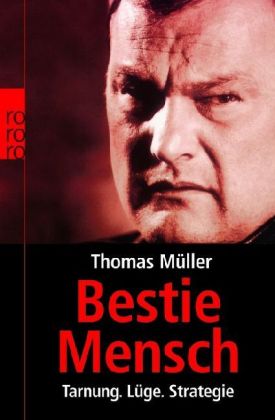
Müller started as a normal police-man in Tyrol but soon began to ask himself the question “Why do people do what they do?”. So he started studying Psychology and writing letters to different institutions around the world, who try to answer this question, finally succeeding in getting a kind of “internship” at the FBI in Quanticor, working with Robert Ressler and developing and finally introducing his method to the police in Austria.
What he’s saying is that every crime takes decisions. And the way some decisions are made can tell us about the needs of the person who did the crime. To find out those needs, it’s important to analyse and compare the decisions made with similar crimes. Müller calls this method crime scene analysis. [It’s different from profiling or forensic psychiatry because it doesn’t ask about the person committing the crime but the behaviour of the person committing the crime.]
While I think his general idea interesting (I have no way of knowing if it’s effective but it does make sense), what I think most important in his theory is his insight that the crimes happen when the communication breaks down. So, as long as there is a way for the person to communicate with someone, they might be very troubled and in serious need of therapy, but they still see an exit. As soon as that’s gone, everything becomes hopeless and the only way out is to commit the acts they’ve previously only fantasised about. [Note also: the role of the media and the way they often portray criminals as non-human monsters is just another way of communication being removed.]
So, for people interested in the less understandable parts of Humans, this is a very fascinating read. People who don’t care about this, won’t care about the book.
 kalafudra's Stuff
Good review.
As a person with policing experience, we were always suspicious of profilers and “analysts” (as Muller calls himself). I can see the benefits of using this approach in investigations, but the practice is dependent on historical factors happening again–this make some profiles grossly inaccurate.
Thanks.
Good to hear the insight of somebody connected with the police. I don’t think that Müller’s approach would be beneficial for every investigation, but I can imagine that it helps in some cases. [For example he writes about various cases which always have in common that a man attacked women at random, raping them and then killing them by stabbing them repeatedly. These cases are fairly similar – enough to be compared.] But I can see the limitations of this practice.
In any case, what Müller does emphasise throughout the book is that his approach is in no case a substitute for a criminal investigation, only a way of supporting it (or at least that’s what he hopes).
[…] Bestie Mensch (The Human Beast) – Thomas M?ller ? Stuff By kalafudra Thomas M?ller is an (or probably the) Austrian criminal psychologist and crime scene analyst (No, he?s not a profiler. Never call him that). Bestie Mensch (translates to The Human Beast) is his first book. Unfortunately, it?s not … Stuff – https://kalafudra.wordpress.com/ […]