Zauber der Ferne – Imaginäre Reisen im 19. Jahrhundert (German) [translates to: The Magic of Distance – Imaginary Travels in the 19th Century] was an exhibition in the Wien Museum (The Vienna Museum, about the history of Vienna). It ran until last Sunday and I just made it last Friday.
The exhibition gave an overview about different methods of travelling without leaving the country, which were popular in the 19th century. It starts with raree shows – big and small wooden boxes with mirrors and painted pictures which tried to give you a 3D-view of foreign cultures.
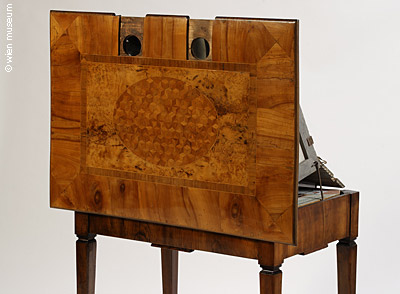
After these raree shows came overviews, where even a stadium was built. In this stadium, people were led through darkened corridors to the middle of it, on top of a stage or balcony, where a panomramic painting – a 360° view – of another city was arranged.
From there on, there came the “Laterna Magica”s, which were kind of slide projectors, just instead of photos, paintings were being projected. With the help of two slides which were laid over each other, you could simulate changing light or movement.
 Image from a Laterna Magica.
From there on was a brief display of games for children and a book by Karl May.
Then we turned to painting again, specifically Cosmoramas, a form of panoramas, where with the help of artificial light and magnifying glasses, a painting was perceived as being as big as real life. A different form of panorama was the diorama – on both sides of the canvas two different paintings were drawn and according to the light, parts of it were obscured or highlighted.
Then we turn away from paintings and to photography: In the middle of the exhibition, a so called Kaiserpanorama was rebuilt. It’s a machine about as big as a small room which enabled the people to see 3D-photographies. [By taking the same picture from two slightly different viewpoints.] The machinery turned the pictures and so about 25 people could watch the 3D world unfold at the same time. The photos shown were of 19th century New York and were very interesting themselves.

After that, we got to the more “hands-on approach”. There was a brief segment about the World’s Fair in Vienna in 1873, where you could walk basically through the whole world (or what was deemed important in it) from representative building to representative building.
Another brief segment was about the Venice in Venna exhibition in 1895, where the most important buildings in Venice were rebuilt in the Vienna Prater (almost exactly in the original size), complete with a channel where you could take boat tours.
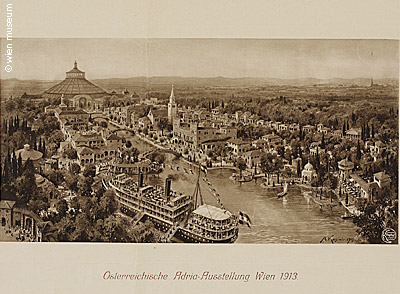
Then briefly other exhibitions were covered – a wax museum, some fun rides, some “people exhibitions” where natives from around the world were brought to Vienna and had to show off their lifestyle.
And finally, we arrived at the theatre, where different stage designs were shown and the movies, were some travel movies were shown. The highlight surely was the movie Le voyage dans la lune by by George Méliès [you can watch it here].
It was a very short exhibition – I took my time and was through after 1 and a half hours. There was some very interesting stuff in there, but everything would have profited from a little more focus and/or expansion.
Political context was completely ignored, which is a pity when it comes to the question why imaginary travelling suddenly surged so much, but is downright dangerous when you talk about the “people exhibitions”. When you have a poster by the Zoo announcing a special programme about Samoa and the only pictures on the poster are by people – are we to assume that there were people shown in the zoo as well? Or was it just the way of the time? I wouldn’t know after this.
But it was an interesting view into the technology of the time…
 kalafudra's Stuff