Liebelei [German] is in turn translated with Flirtation, The Reckoning, Dalliance or Sweet Nothings, depending on the translation you read. It’s one of the earliest plays by Arthur Schnitzler.
[I read it because I saw a new adaptation, which I’ll review tomorrow.]
Plot:
End of the 19th, early 20th century, Vienna. Fritz and Theodor are best friends, both pretty wealthy but have a very different outlook on life, though both are ultimately jaded. While Dori doesn’t seem to take anything seriously, Fritz is in a rather destructive relationship with a married woman and fears that her husband found out about them and will challenge him to a duel. Dori tries to distract Fritz by introducing him to his current girlfriend Mizi’s best friend, Christine. But Christine really falls in love with Fritz, and quite hard at that. During an evening of partying, the husband actually shows up at Fritz’ place.
Liebelei is a very fluid, quick read and it’s an interesting look at the influence of personal and social moral on relationships. I had my problems relating to Fritz and Christine, but I quite liked Dori and Mizi. In any case, these are interesting, well-rounded characters in a play that asks interesting questions.
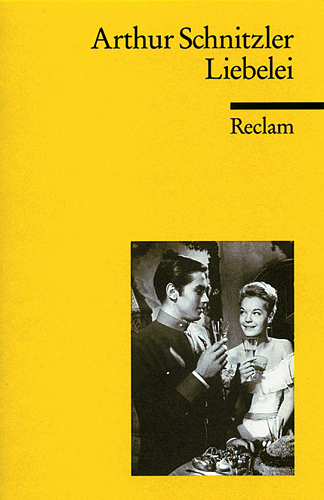
The first half of the play focusses on Fritz and sets up their situation, the second half is the Christine show. Schnitzler uses this perfectly to set off the differences between both their worlds.
But as I said before, I had my troubles emphasising with both Fritz and Christine. Fritz seems to honestly care for the woman he has the affair with, but at the same time it is pretty clear that she doesn’t care about him that much. At the same time, Fritz uses Christine and Christine’s admiration and love for him pretty cruelly, even though he could use his own experience to realise how hurtful he’s behaving.
Christine on the other hand was so completely melodramatic and adolescent. Her love is what the fictional love is supposed to be like: never-ending, without questions and doubts about her feelings and without conditions. Yet in this realistic setting, it only seems naive and ridiculous – and you want to throttle Christine and tell her to grow up.
Dori and Mizi are much better. They’re cynical, yes, but they’re also honest with each other and don’t try to deceive each other – and they’re realistic. Which also explains why their story doesn’t end in tragedy.
I think this is a play that improves on re-reading and/or rewatching. At first glance it might seem a little inconsequential and a little clichéd but it is neither.
Summarising, definitely recommended.
 kalafudra's Stuff
[…] Nothings is a new translation of Arthur Schnitzler‘s Liebelei [my review] by David Harrower. The play was produced for the Young Vic in London, directed by Luc Bondy and […]