It’s Festwochen time again! [For my reviews of last year’s plays, click here.]
Lipsynch is the newest play directed by Robert Lepage (whose Andersen Project I saw last year), written and acted by Frédérike Bédard, Carlos Belda, Rebecca Blankenship, Lise Castonguay, John Cobb, Nuria Garcia, Marie Gignac (writing only), Sarah Kemp, Robert Lepage (writing only), Rick Miller and Hans Piesbergen.
Plot:
Lipsynch is divided in 9 chapters, each focussing on one person, though all the chapters are connected with each other and revolving around the themes of familiy, language, voices and communication and the impact communication (or the lack of) has.
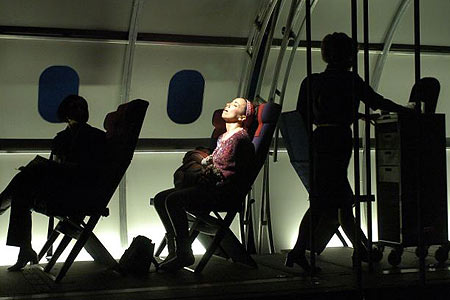
Chapter one tells the story of Ada (Rebecca Blankenship) an opera singer who witnesses the death of a young woman on a plane. The young woman had a baby with her – Jeremy (Rick Miller) – which Ada ultimately adopts. Later she mets Thomas (Hans Piesbergen) and falls in love with him.
Chapter two is about Thomas, a neurosurgeon who, despite being with Ada, falls in love with a singer he treats for a brain tumor, Marie (Frédérike Bédard).
Chapter three is Marie’s story, her recovery after the surgery and how it affects her relationship with her (dead) father and her (mentally ill) sister, Michelle (Lise Castonguay).
Chapter four is Jeremy’s story, who has grown up to be a film maker and who shoots a movie, with which he tries to come to terms with his birth mother’s story.
Chapter five focusses on Sarah (Sarah Kemp), an ex-prostitute who now works as a cleaning woman for an older woman (who in turn is a mother figure for Ada). When Sarah stumbles upon radio reporter Tony Briggs (Rick Miller), she thinks that she recognises him from her past.
Chapter six is about Sebastián (Carlos Belda), a sound technician who has worked with Marie and Tony Briggs. Sebastián is called home to bury his father.
Chapter seven is about Jackson (John Cobb), a police officer in the middle of a divorce, who has to investigate Tony Briggs’ death.
Chapter eight is Michelle’s story after she gets released from the psychiatric hospital and has to rebuild her life.
And finally, chapter nine is about Lupe (Nuria Garcia), Jeremy’s birth mother and the story of how she got sold from Nicaragua into sex slavery in Germany.
Lipsynch is called a “Dramatic Marathon” and that’s definitely true for everybody directly involved – it’s 9 hours long (including breaks) and all the actors have multiple roles and are almost constantly on stage. But for the audience, it is one hell of a treat. The time passes quickly, the stories are completely engaging and the cast is really good. If you got 9 hours to spare, you should see it.
I was slightly worried before seeing the play, because it is 9 fucking hours long. But I remember The Andersen Project so fondly that I figured I’d give it a chance – and if it doesn’t work, I’ll just leave early. But it worked perfectly. Not only was the organisation of the whole thing very well done – everybody got a bottle of water in the first break and there was a big break where we got a warm dinner (included in the ticket price, which was pretty cheap already), it was also really entertaining the whole time through. I have definitely seen plays that felt longer than this one.
Lipsynch is shown in four languages – English, French, Spanish and German, depending on the story that is told and who’s talking. [In our case, everytime it was not German, we got subtitles.] It’s pretty amazing since each character has a different accent, too. I think that’s a big part of what makes Lipsynch so great – that the voices are that easily separated and still make a whole.
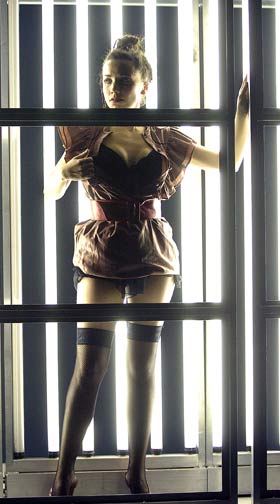
Each of the chapters, or acts, are rather different. They range from very serious to very lighthearted, silly even, and everything in between. Revolving around the main themes I mentioned above – familiy, language, voices and communication and the impact communication (or the lack of) has – every act touches on different topics and I think probably everyone in the audience has different favourites among them (mine were Marie, Jeremy, Michelle and Lupe).
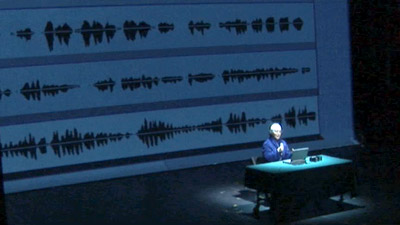
As in The Andersen Project, Lepage works the new media well and fits them seamlessly into the whole play. But generally speaking, the set design was absolutely brilliant. It was really clever, quickly changed into other things and yet very evocative.
And the cast was great. All of them.
Summarising, don’t let the length of the thing scare you – Lipsynch is very much worth the time.
 kalafudra's Stuff
[…] didn’t resonate as much with me as the previous two by Lepage I saw (The Andersen Project and Lipsynch). Maybe because it wasn’t as funny, maybe because it was too hot in the theater and doing […]