Controversies: The Law, Ethics and Photography is an exhibition currently (until June 20th) in the Vienna Kunsthaus.
The exhibition gives an overview over controversial photography, with any given meaning for controversial: Some of the photos are controversial because of their subjects, some because of copyright issues. The exhibition was arranged chronistically, which personally, I didn’t like that much. I would have appreciated a more theme-focussed approach. Like one room: Copyright. One room: Is this pedophilia? One room: Depicting war or refusing help? etc.
But generally speaking, it was a very interesting exhibition and I could understand most of the controversies, though there is barely a picture where I couldn’t decide whether I approve or not. What I mean is, I understand why people might be torn about the pictures, but for myself, I could draw pretty clear lines.
Anyway, after the jump, some of my favourite examples! I’ll spare us all the war pictures, though.
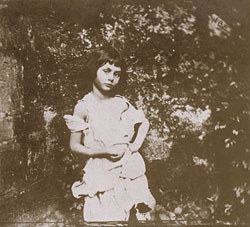 This is a photograph, Lewis Carroll took of “his” Alice and it was the first and (probably) most damning thing that made him look like a pedophile, because of the way Alice is dressed and looks at the camera.
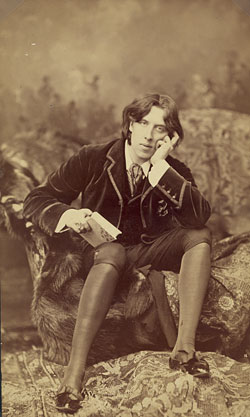 Napoléon Sarony‘s photo of Oscar Wilde was the first to achieve the legal status “piece of art”, ensuring that it’s copyright was protected.
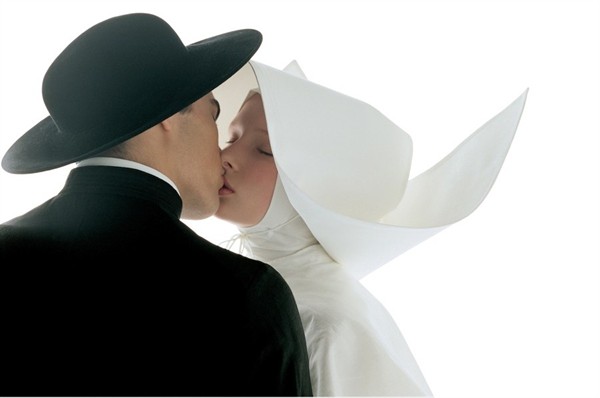 They had a whole bunch of Oliviero Toscani‘s Benetton pictures, this featuring most prominently. I like it.
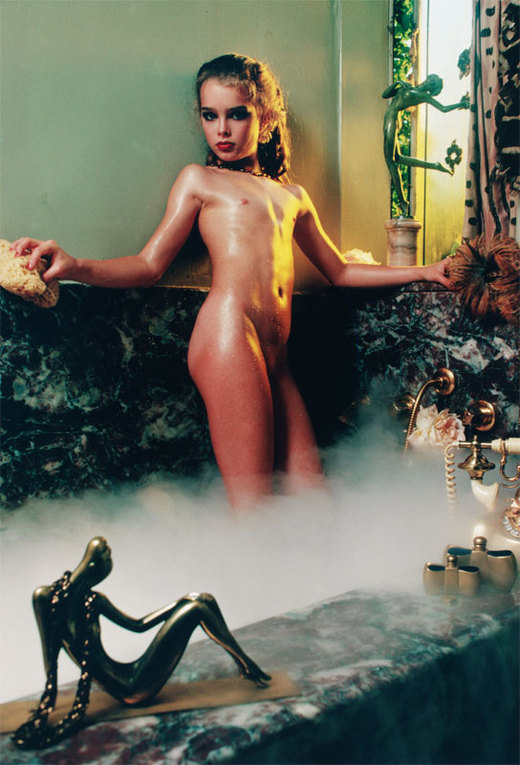 I thought that with this picture by Garry Gross (showing Brooke Shields), there was no doubt about the pedophilia. I mean, it’s titled “The Woman in the Child”, for crying out loud.
[Generally, I found their treatment of the pedophilia part pretty interesting. For example, there were only pictures of girls. Apparently, when a naked boy is photographed by a man there is no doubt about it being perverse…]
But the bigger controversy surrounding the pictures from this series was Brooke Shields trying – and failing – to prevent further publication of the pictures. Which I think is a pretty awful legal decision, but there you are.
Anyway, to end this on a less heavy topic, there’s this:
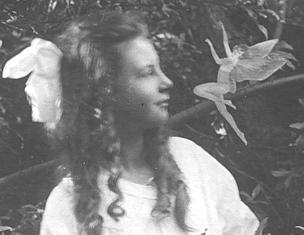 In the 1910s two cousins faked pictures of themselves with fairies and people totally believed them and even though they both admitted to faking the photos with cardboard cutouts (one of them later retracted) in the 80s, there still seem to be people who believe them…
 kalafudra's Stuff
[…] https://kalafudra.wordpress.com/2010/06/04/controversies-the-law-ethics-and-photography/ […]