Rechnitz (Der Würgeengel) is a play by Elfriede Jelinek. She had originally barred it from being shown in Austria but made an exception for the Festwochen. It was directed by Jossi Wieler [German] and stars Katja Bürkle, André Jung, Hans Kremer, Steven Scharf [German] and Hildegard Schmahl.
Plot:
Rechnitz is a town in the East of Austria, where in 1945 during a party by Countess Margit von Batthyány, Nazis killed about 200 Jews as part of their entertainment. Until today, the remains of the victims were not found, neither was the whole affair properly investigated.
The play itself doesn’t really have a plot. It consists of five people, referred to as Delivery Persons/Messengers, telling the story of the massacre in ever repeating circles.
Before I say anything else, let me perfectly clear: I don’t get Jelinek. I don’t get why she’s famous, I don’t get why she’s so fucking complicated and I don’t like her style. I wouldn’t have watched this play if my whole family hadn’t said that they wanted to see it, too and as an Austrian I think it’s my responsibility to a) confront myself with WW2 on a regular basis and b) see at least one Jelinek play (I have read one of her novels already, so I can check that off my list*).
Bearing that in mind, I really did not like the play.
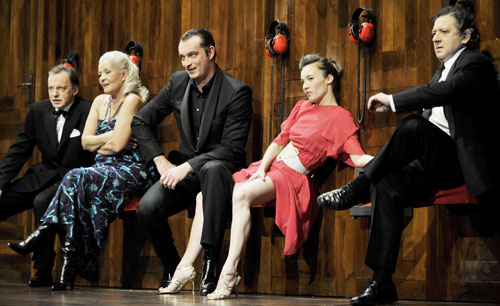
Qualitatively, it was an excellent production. The actors were awesome – and playing Rechnitz must be a tour de force, especially under the direction of Jossi Wieler – he really doesn’t cut them any slack. The focus is one hundred percent on the actors and they’re on stage practically the whole time. The play, btw, is almost two hours long and there’s no break, so there’s that, too.
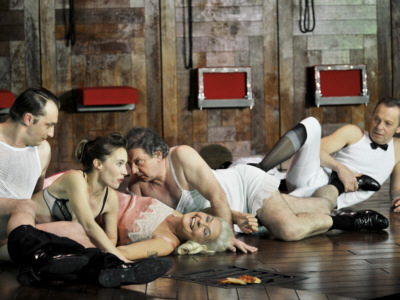
I also liked the stage design which was extraordinary but fit the play very well.
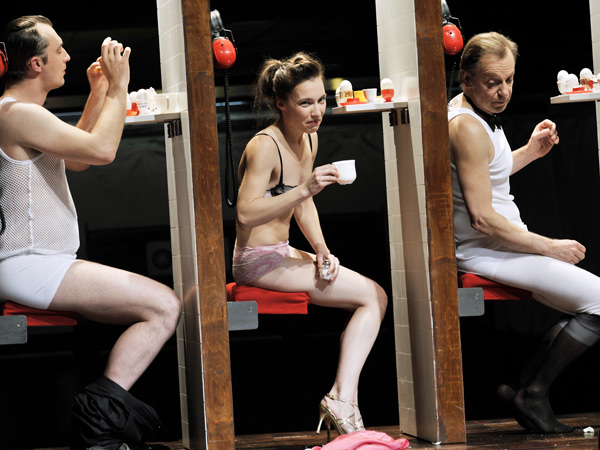
But I was sitting in this play and caught myself thinking about something completely different every five minutes. Then I’d chide myself and listen for another minute or two and then my mind would begin to wander again… Which makes it very practical that they kept repeating themselves all the time, but my suspicion is that if they hadn’t repeated themselves all the time, I would have been better able to listen. Also, I don’t go to the theatre to think about the cute guy I met that other time or that I have to do my laundry. I go to the theatre to watch and listen to a play. [A friend compared watching a Jelinek play to listening to jazz, which is a pretty apt comparison. I don’t like jazz, either.]
Anyway. Jelinek’s language is completely artificial and I’m sure that she intends it that way. But this, for me, has two effects: 1. I keep picturing Jelinek in her study, typing away on a typewriter, continuously congratulating herself on her genius for finding yet another word play. 2. It completely removes me from the story. And it’s a horrifying story, so I should be horrified by it. Instead it has all the emotional impact of a wet baguette.
Summarising: everybody I was with liked the play, so maybe my reaction is very weird. I guess, if you’re interestd in theatre, you’ll have to see a Jelinek play at some point. Then it might as well be Rechnitz.
Here are some clips from the play:
—
*I read The Piano Teacher and I thought it was okay, but nothing to write home about. I was rather young, though, when I read it so I don’t exclude the possibility that I didn’t get everything. I’m not going to find out by reading it again.
 kalafudra's Stuff
Is the Rechnitz story true? This is so sick, even for nazis.
PS: I also read the piano teacher and thought it totally overrated.
The Rechnitz story is true, yes. Though I’ve been told that Jelinek doesn’t really get all the details right/didn’t care about the details/used poetic license.
But the basic story as I’ve written it above? That happened.
Humanity makes me very sad sometimes. And the idea that it was exactly my people committing these crimes isn’t exactly cheeful either.
I always wonder about these Austrian people who say that they don’t feel the guilt as they were not acting criminal and not part of the generation. I feel bad about all the sick things humans do. But the strongest feeling of sadness is about these nazi-crimes not only because it was especially terrible but also because it was my people who murdered.
Historical detail:
I think they have sucessfully been trying to find the massgrave in Rechnitz about ten years ago. I remember something like that.
There was a similar case not too far from Rechnitz, actually, I think that’s where they found the bodies from. But I’m not sure.
—
I also think it’s interesting that people are unable to distinguish between collective responsibility and individual responsibility. That I can say, personally, I wasn’t alive during WW2, I didn’t pull the triggers, but collectively, as Austrians, we have a responsibility to atone and to unearth and to process.
I think it’s flabbergasting that people. just. don’t. get. that.
Yes my name is Rechnitz and my ancestors came from that little town to Poland some generations ago.
Luckily enough both my parents were zionists (yes this was acompliment) and left Europe early 1920’s to Palestineto build Israel.
The hideos Rechnitz massacre was doccumented in afilm during the 1960’s called “Rechnitz”, made in the town while quite a number of the local participants were still alive and most of them “couldnt remember”.
One of my ancestors’ family name is “Rechnitzer” – This is how I got to hear about this horrible case and the play. I’m going to watch the play next week – the Munchner Kamerspiele will be performing it twice in Israel.