Im Labyrinth des Schweigens [literally: Labyrinth of Silence]
Director: Giulio Ricciarelli
Writer: Elisabeth Bartel, Giulio Ricciarelli
Cast: Alexander Fehling, André Szymanski, Friederike Becht, Johannes Krisch, Hansi Jochmann, Gert Voss
Seen on: 26.2.2015
Plot:
Johann Radmann (Alexander Fehling) is an ambitious attorney, always on the look-out for new career opportunities. One of those presents itself when journalist Thomas Gnielka (André Szymanski) shows up with a survivor of the Auschwitz concentration camp, Simon Kirsch (Johannes Krisch). Simon has seen one of the former Auschwitz guards, working as a teacher in a school and he wants him investigated and arrested for the crimes. But the memory of World War 2 is still fresh and people would rather forget. After all, the Nürnberg trials happened already and isn’t that enough? But Johann doesn’t want to leave it be. He takes up the investigation, slowly uncovering the atrocities that were committed there.
Im Labyrinth des Schweigens focus on the slow process of dealing with the aftermath of World War 2 and does so rather effectively, if sometimes a little formulaic.
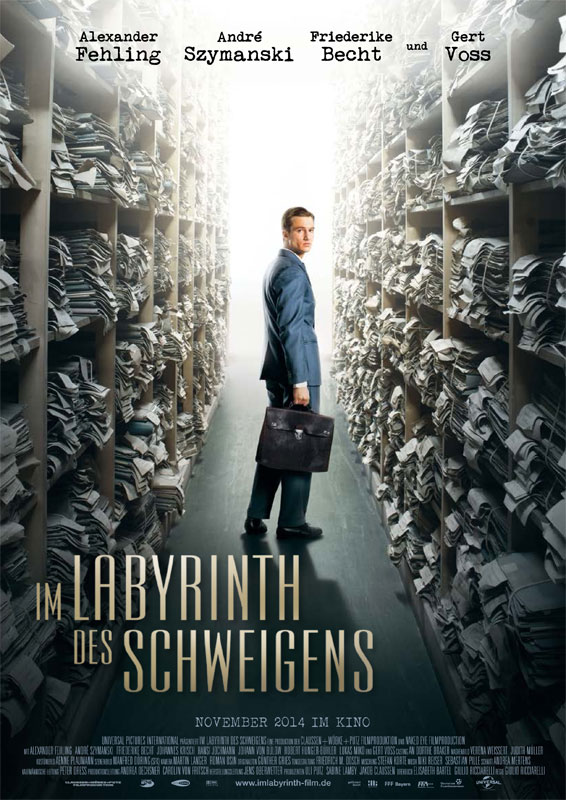
The film is set almost 20 years after World War 2 and it is really astonishing that even 20 years weren’t enough to ensure that justice was done by the system, that it needed a new generation – who didn’t actively participate in the war – to tackle the problem, but who were still hindered by most older people. (At least in Germany they faced up to stuff at all. In Austria people still like to cry about being victims of World War 2 just like everybody else, which is utter bull.) I don’t know how historically accurate the film is in all other regards, but that is certainly true.
The script manages to make Radmann emblematic for an entire generation’s reaction to WW2 (my parent’s generation or a little older): they start off with the utter conviction that your own family wasn’t involved, that it was clear who the bad guys were and with anger at the lack of reparation work done after the war, and they end with the realization that it won’t be possible to ever cut out the bad parts of society and punish that part alone because everybody was involved and everybody has that bad part. That means that we are all responsible, even the following generations. [Unfortunately that message still hasn’t sunk in for many people.]

While the political parts of the movie work very well, the more personal stuff doesn’t, in particular Johannes’ relationship with Marlene (Friederike Becht) never really felt real, it felt completely artificial. That is neither Fehling’s nor Becht’s fault, but rather due to the fact that Marlene was only there so we get to see Johannes’ private reactions as well, making her a reflective surface for his emotions and that just isn’t enough to sell a relationship on film.
At least Fehling does a good job with said emotions and it is a joy to watch him act. Generally the cast is really good and the film has a very nice look, in both cinematography and production design. Combined with the politics, it makes the weaknesses easy to forgive.
 Summarizing: Worth watching.
 kalafudra's Stuff