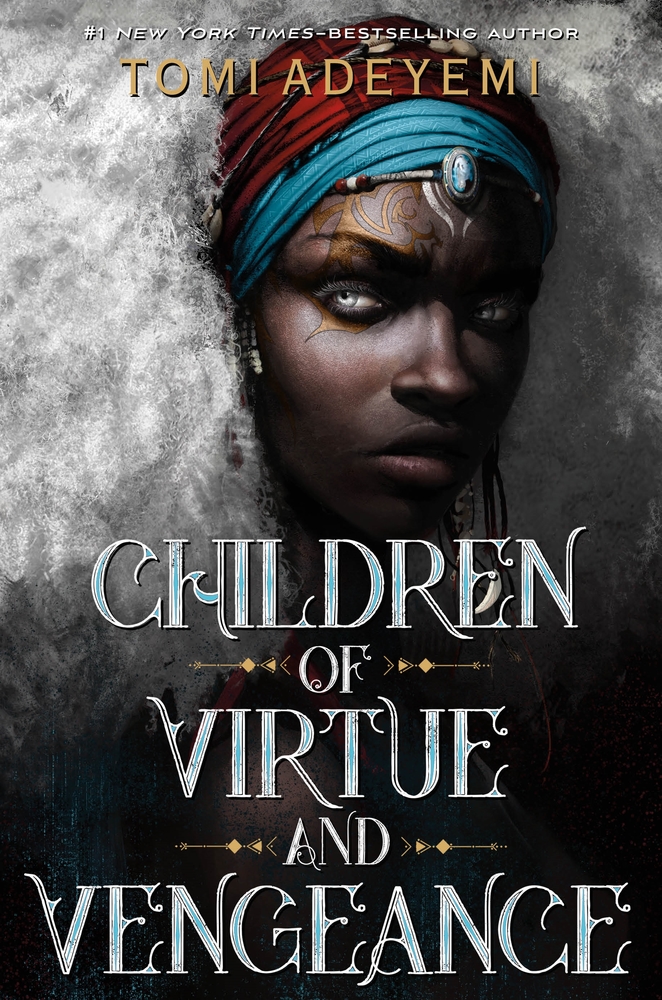
Children of Virtue and Vengeance is the second novel in the Legacy of Orisha trilogy by Tomi Adeyemi.
Finished on: 3.8.2024
[Here’s my review of the first novel.]
Content Note: war crimes, genocide, slavery
Plot:
After the King’s death, Zélie, Tzain and Amari have to figure out their next steps. Amari has a claim on the throne, so she hopes that she can reach her mother with the help of mercenary Roën and get her blessing for the coronation. Amari has big plans to finally unite Orisha. But the return of magic has shifted the politics considerably. New maji rebels are determined to tear down the royal family, or what remains of it. There is a new class of magically gifted nobles. And Amari’s claim on the throne might be more tenuous than they all anticipated.
Children of Virtue and Vengeance is an excellent continuation of the series and expansion of the world, leaving us with an entirely new direction that I did not expect. It doesn’t shy away from complicating matters and putting its characters, or its readers, through the wringer. I am looking forward to the final novel.
Damn, if you told me that I read Children of Blood and Bone first six years ago, I wouldn’t have believed you. Where does time go? Back then, I liked the first part of the series, but I wasn’t overly enthusiastic about it, even wondering whether I’d continue with the series. I have re-read the book before diving into book 2, just to refresh my memory, and I have to admit that it worked much better for me the second time round, with adjusted expectations and having put any thought of a romance between Amari and Zélie to bed.
Where Children of Blood and Bone was a book about an evil king oppressing a part of his people, Children of Virtue and Vengeance is more about the question what good leadership looks like. Or rather, it gives us many examples of what it isn’t. Amari, who was slated to be a great queen, starts to sacrifice more and more of her integrity to get to the power that isn’t handed to her. Zélie is traumatized and pushed into a leadership role that she feels she can’t say no to, never really making the choice to fill it, though. Inan (the most annoying character in my opinion because of his weak will) continues to be a plaything for pretty much anybody, too insecure to make any kind of decision that sticks, even when he has good intentions. Nehanda is simply a fascist. Roën leads with fear. Arguably, Mama Agba is the only authority figure with actual leadership qualities in the book. (Tzain remains unused as a character.)
This is not always easy to read about, and often I wanted to shake the characters for their decisions (none more than Inan), but while it doesn’t make the characters “good”, it makes for really good reading. Their moral struggles are complex, and you can always understand where they are coming from, even if their decisions are bad – ranging from ill thought out to catastrophic. One certainly can’t claim that Adeyemi doesn’t let her characters grow, but they don’t necessarily grow into better people.
And then there is the ending that seems to come completely out of nowhere. I mean, with Roën we were already introduced to the fact that the world here is bigger than Orisha and Fantasy!Africa, but still, bringing slave trade (I assume) into play is still a change of pace that I (as a white person) found a both shocking and interesting choice. It certainly made me glad that part 3 of the series is already out and can be read anytime now.
Summarizing: an excellent sequel.
 kalafudra's Stuff