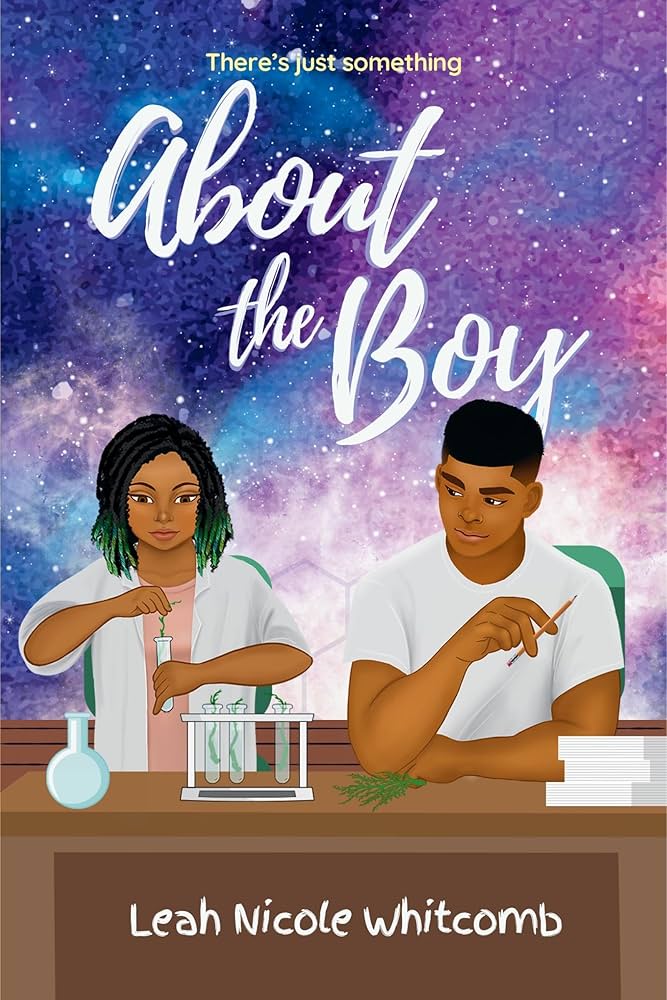
About the Boy is the first novel in the Redbud Springs series by Leah Nicole Whitcomb.
Finished on: 23.12.2024
[I won this book in a LibraryThing Early Reviewer give-away.]
Plot:
Naima is sixteen years old and just wants to get through high school unscathed – not too easy when you’re autistic, Black and female. Fortunately, she has two really good friends in Sam and Luna, and she is excited about her AP Biology class. But then a new kid shows up. Kamron is gorgeous, instantly popular and he is now the second Black kid in AP Biology – one who doesn’t fidget and immediately upstages Naima. When Naima is paired with him for their lab work, she is almost ready to throw in the towel. But her future rides on the class, so she will fight.
About the Boy is a sweet story that tells a familiar story with characters rarely seen in novels in terms of their diversity. It is the start to a series that – contrary to most romance series conventions – continues with a focus on Naima and Kamron, which I personally didn’t love that much, but other than that, I liked it.
About the Boy is no revolution when it comes to the romance. It’s your classic enemies to lovers story, even – as it turns out – the enemy part if only one-sided. But that is par for the course, I’d say, in the trope and genre. It’s not my favorite trope, but I do enjoy it and I did so here.
It is a bit of a revolution when it comes to the characters and their diversity. Black romance is still a (much smaller) subcategory to a predominately white genre, and add neurodiversity to the mix and it becomes even more special. Naima is also not compeletely thin, though I’d hesitate to call her fat – when it comes to that representation, the book names clothing sizes, but other than that doesn’t really engage with the reality of being a bigger teen, so that one doesn’t count that much for me.
It is much busier with Naima’s autism, and I got the distinct impression from the writing that it was a central concern for Whitcomb to do right here. But there was a certain distance in the description to me that made me think that Whitcomb probably isn’t autistic/neurodiverse herself, but rather researched being autistic as much as she could. That is pure speculation on my side, though, not something I can really pinpoint.
For me, the parts that worked best about the book were Naima’s relationships with her parents. With her mother, it’s a contentious relationship where often impossible things are demanded from Naima. But at the same time, there is a genuine concern and warmth present – and I loved that juxtaposition, that felt completely natural, as painful as it often was to read. With her father, it’s a story of grief as he died a few years ago, and I loved how Naima still relates to him, and how the entire family still struggles to process. I also really appreciated the way COVID is acknowledged here as part of Naima’s past and present, and how it complicates her grief even though her father didn’t die from it.
When I realized that the next novel(s?) in the series would continue Kamron and Naima’s story (instead of, say, switching to Luna or Sam), I was a little surprised (though the hints at a love triangle with Sam being interested in Naima that never come to fruition in this book make a lot more sense now). I think I would have liked it differently, though it doesn’t keep this book from having enough closure to make it a satisfying read.
Summarizing: very cute.
 kalafudra's Stuff