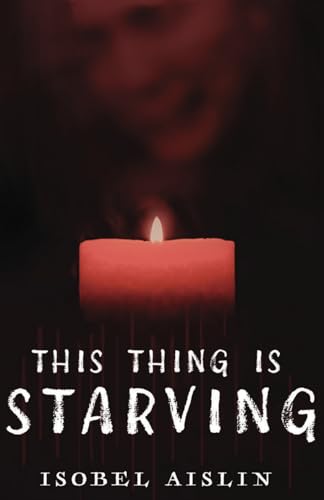
This Thing Is Starving is the first novel by Isobel Aislin.
Finished on: 31.12.2024
[I won this book in a LibraryThing Early Reviewer give-away.]
Content Note: domestic violence, infanticide, suicide, (critical treatment of) misogyny, queermisia, (mention of) sexualized violence, CSA
Plot:
The House was resting, sleeping almost, when a new family moved in. A mother, four children. They disturb its peace, but there is something about the oldest daughter, Veronica, that catches the House’s attention, that prompts its protective instincts. But when the House protects something, it doesn’t always go right. As the presence of the new family brings up old memories of the violence that created it in the first place, the House has to contend with the fact that Veronica faces much of the same.
I was sold on this novel when I read that it was told from the perspective of the haunted house. That it is also an outspokenly feminist piece of work that tackles patriarchal violence very directly only made me want to love it more. Fortunately, the book kept its promises – it’s a forceful and engaging work that kept me hooked.
Not only is the idea of writing the book from the House’s perspective a very creative one that I thought really strong, it is also the perfect set-up to explore various flavors of misogynistic and queermisic violence. With the various stories feeding into the house, we get domestic violence, femicide, transmisia, homomisia, acemisia, sexualized violence and child sexual abuse. It is not easy fare, but it is handled carefully and never too graphically. Sometimes, it leans into a more educative tone that wasn’t exactly necessary, but I didn’t mind it either.
That the House is about a century old, also gives the book the opportunity to show that while some aspects might change throughout history, patriarchal violence remains pretty much the same at its core. In 2024, fake revenge porn is a new technological possibility, but the underlying demand that a woman and her sexuality belongs to a man, is owed to him, that is the same in the 1950s as well.
With books as obviously occupied with a point they want to make as this one, the story aspect can suffer a little. They have a tendency to feel a little too academic to be emotionally affective and effective. But that is not the case here. While I thought that the horror could have been a little more present, I was emotionally invested in the characters and their stories, which kept me hooked and had me blazing through the book in a rather short time.
There is a reveal in the end (about Veronica’s connection to the house) that I thought a little too contrived – I didn’t think it was necessary. But that is really my only major complaint about the book. And that isn’t much of a complaint in any case. Yes, there are some moments where my inner editor was activated, yes, there are some “first novel” issues here and there, but all of them are easily outdone by the book’s strengths.
Summarizing: if you like horror, read it.
 kalafudra's Stuff