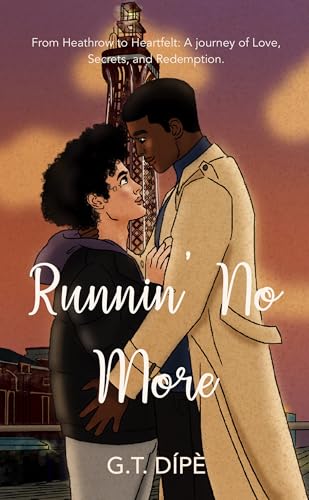
Runnin’ No More is the first novel by G.T. Dípè, the first in a duology.
Finished on: 17.1.2025
[I won this book in a LibraryThing Early Reviewer give-away.]
Content Note: stalking, (critical treamtent of) homomisia
Plot:
Teniade just arrived in England with his sister Jola. While Jola has a job at University secured, Ade’s decision to leave Nigeria wasn’t a plan as much as a flight. Now he has to decide whether he wants to study at Jola’s University. The decision is almost made for him when he realizes that Stefan also goes there. They bumped into each other at the airport and the chemistry was immediate and intense. But Stefan has his own dark reasons for having left Sweden behind. All of those things threaten to catch up with them and get in the way of their new-found connection.
I am always looking for queer romances, and if they have some racial diversity (or disability rep), it’s even better, so I was looking forward to reading this. Unfortunately, we were off to a rocky start with the epigraph already, and things only got worse from there. It just did not work for me at all.
When I opened up the book and the epigraph was from Jean Cocteau as quoted by a character in Red, White and Royal Blue, I was immediately taken aback, and not just because that book didn’t work that well for me either. If you want to quote Cocteau, you might want to read what he wrote himself? Especially if the quote is so important to you that you start your book with it? Maybe a little more context for that quote would be good? I don’t know, I just found it irritating as hell.
But it was a good indication that what I think is important and what Dípè thinks is important does not align at all. I felt like I got bombarded with superfluous information throughout the entire book. I mean, I know pretty much every song they ever listened to in the time period the book covers, but I was constantly confused as to who was living where and with whom. Car and cell phone models are thrown at you, but I don’t know what Stefan’s parents do for a living that he actually has a bodyguard/driver. (I mean, that’s not Swedish standard, at least not in my extended Swedish family.)
The book also mistakes being a fan of something and referencing it with adding depth to its story and characters. It is a well-established trope to draw on another work to emphasize some parallels in stories or to highlight where your story differs from that other work, but Stefan’s obsession with the Shadow Hunter novels – that spreads to pretty much every character around him – just feels like Dípè wanted to share her joy with the novels and it doesn’t actually do anything for Teni and Stefan. And, good for her! I am happy that she loves those books that much. I just didn’t. In fact, I found them not particularly good and rather icky for the most part.
So, the information management in the book sucked for me. We learned too much of the wrong information and too little of the characters as people. That there is a subplot going on with Jola that is actually a preparation for a sequel (Guilty No More) is just the book getting way ahead of itself and, again, focusing on the wrong things. That they are all fantastically rich, makes them also feel unmoored from this reality. (When Jola is given a FRICKING CAR – a brand new Mercedes Benz GLP 250 SUV to be precise, because Dípè is – as a birthday present from her love interest, my jaw literally hit the floor.)
The dark themes that the book covers – stalking and homomisia – are resolved in a rather superficial manner that feels equally simplified. Plus, that Teni keeps haranguing Stefan to report his stalker is exactly the kind of pressure you shouldn’t put a survivor of this kind of violence under: Stefan clearly says that he doesn’t want to report it, and then his boundaries aren’t respected yet again and he is “encouraged” until he gives in, and this is the happy end? No, that is just a re-enactment of a disrespected No.
In the beginning, I was willing to cut the book some slack. When Jola – who is Stefan’s lecturer – hires him for a research project after the very first introductory lesson where they didnt actually cover any science, I was willing to suspend my disbelief (although Dípè is a PhD student herself and should know better how academia works). When I was confused by what day it was and how much time had passed, I chalked it down to me being inattentive. But the more the book went on, the more those things piled up. Ultimately, they took me completely away from the romance that should have been the center of the novel – as you can probably also see from this review. There could be a good book here, but it would need a good editor and a lot more work yet to carve it out of what we have here.
Summarizing: I would have liked to like this one better.
 kalafudra's Stuff