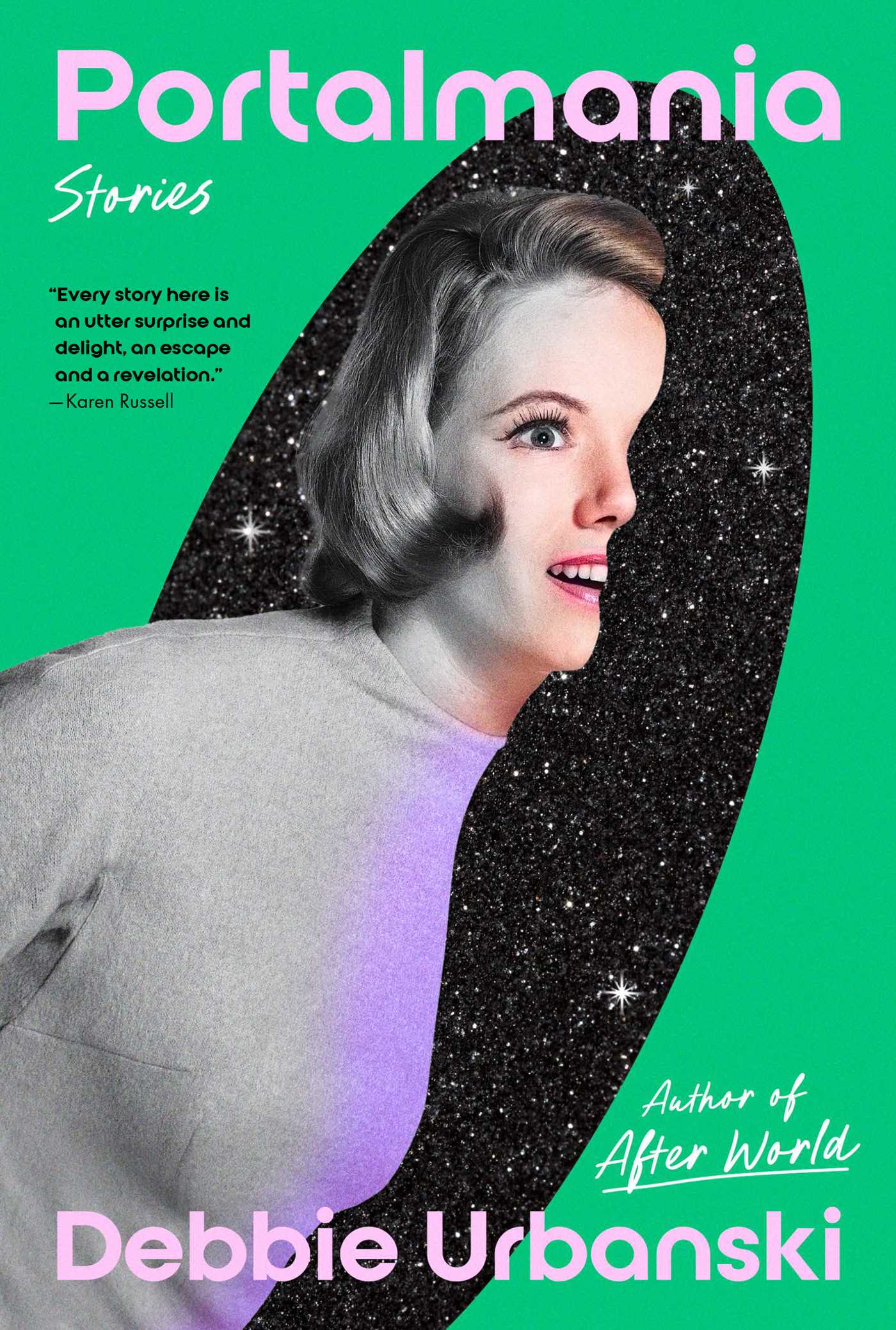
Portalmania is a short story collection by Debbie Urbanski.
Finished on: 29.5.2025
[I won this book in a LibraryThing Early Reviewer give-away.]
Content Note: (marital) rape, domestic violence, child abuse
The short stories in this collection are variations on a few themes. Portals and other ways to strange worlds are a part of all of them, but they also share a sharp, often uncomfortable look at what it means to be an asexual woman married to a man who not only wants to have sex but expects to get it. As a therapist myself, it is also almost a guide how not to approach asexuality with patients (the therapists here gave me a whole lot of creepy vibes). And finally, the story also deals with autism, once very overtly, in other stories more in passing. Even though the themes are so similar, often sharing more than one element, the stories feel very distinct and are each captivating in their own way. In short, it is a fantastic collection, although it is not always easy to stand reading about the very painful experiences of the characters here.
Read more about each of the stories below.
The Promise of a Portal
When the narrator was a child, women in white vans kept showing up, bringing children – mostly girls – through portals into other worlds. The narrator always dreamed of being taken herself, but it never happened. But the thought of a portal still stays with her.
This first story was probably my least favorite of the collection, although I very much liked the concept and the narrators unending longing was very palpable. The ending felt a little abrupt though and left me wanting for something else. Maybe that was on purpose, to mirror the narrator’s wanting, but I couldn’t shake a little dissatisfaction.
How to Kiss a Hojacki
Michael’s wife is changing, is becoming one of the Wonderfuls, a Hojacki. Michael doesn’t know how to love her anymore, especially since her change includes not wanting to be touched anymore.
This story was heavy indeed. That the first encounter with marital rape in this collection is written from the rapist’s perspective, and the victim was turned into something Other before, should almost make it easier to read about, but it might have made it even harder. The casual disregard with which Michael never reads his wife’s messages, the fact that he mostly talks about “his wife” instead of calling her by her name, Lisa, it is all incredibly suffocating. At least the therapist in this story isn’t a complete loss, although not particularly helpful either.
Long May My Land Be Bright
In a United States divided into odd days, where right-winger Carl Elliot is president, and even days, where leftist Lillie Jetrin is president, the division is continued with growing rifts between this reality and another world.
I think what I enjoyed most about this story is the way the narrator changes her narration depending on whether she writes on an odd or an even day, showing how she tries to adapt to the two realities that surround her. Of course, living in two realities is not really sustainable in the long run. This story definitely has a more humorous vibe than the other stories, although it is not without darkness for sure.
LK-32-C
Beth struggles with her son Luke, who seems to live in his own world: LK-32-C, a planet possibly suited for human life that he imagines in all detail. Due to behavioral difficulties, he has recently moved to a therapeutic boarding school. Beth and her husband get to visit him now, hoping to reconnect.
As somebody who works with autistic children, this story struck particularly close for me. Beth’s struggle with her autistic son (the diagnosis is never stated explicitly in the story, but it is pretty obvious to me, and confirmed by the author’s story notes), how to relate and to parent him, is captured in such a disturbingly clear way, it broke my heart in at least six different ways. We get to meet Beth and Luke when things are really fucked up already, but there are glimpses in the story where it might have ended differently if Beth had been able to make different choices. That is not to say that it’s all her fault (this story, too, features a series of very questionable therapists, for example, and Beth’s husband leaves her very much alone with all of it), and maybe in the end at least, they make the right decision by giving (Luke) up. But the story really isn’t that much about “what they should have done” and much more about “and this is how it goes sometimes, and maybe more often than we would like”.
A Few Personal Observations on Portals
In a small town, portals start appearing to people. They are personalized, they are hypnotic and people are drawn to their portals. The narrator is afraid that her own family will also get a portal, that they will leave when she hopes for everything to stay the same.
I loved the portals in this one, probably my favorite instance of portals in the collection. The way the narrator tries to hold on to her family and to things in general, so that things won’t change (I would read her as autistic, in fact) and so that she won’t be alone was also striking. This story, too, carries some heartbreak and a lot of loneliness despite all attempts to connect.
The Dirty Golden Yellow House
A monster kills a husband as a wife hides upstairs. The wife has summoned the monster somehow. Maybe the husband deserved it? But what does the wife deserve?
The Dirty Golden Yellow House was one of my favorites of the collection, thanks to the inclusion of the I-narrator who keeps butting into the story, both apart and separate from it, but also thanks to the witch and the way the story unfolds. The price the wife has to pay is harsh indeed, but it is also understandable that she is willing to pay it. Even more understandable, though, is that she destroys herself in a different way for paying it.
Hysteria
Rebecca tries to talk to her therapist about her husband and the way he rapes her.
This story – it’s short, it’s almost entirely dialogue and I just wanted to kick this therapist and take away her license to work. It made me at least as angry as Rebecca.
Some Personal Arguments in Support of the BetterYou (Based on Early Interactions)
The narrator is asexual and depressed, her husband is neither. So they decide to try a BetterYou, a copy of the narrator, only better.
In the story notes, Urbanski notes that she had almost given the collection a different dedication, a dedication to couples therapists who destroyed her life and asked her to pay for it. This story is a vivid example of really bad therapy (again), and what it means to edit yourself (your true self) out of your own life.
The Portal
Amber saw a portal twice, and the second time, she went through and landed in Mere where she was happy. But by accident, she came back into her original world, a world that asked her to leave Mere behind forever.
This story, too, plays around with the narrator point of view, featuring Amber’s writer as another narrator to the story. This is not only interesting to read, it also brings the fantastic elements more clearly into conversation with what they stand for in the real world. Urbanski mentions in the story notes that she reworked the ending of the story for this collection to be happier, and I am glad she did – I really loved the hopeful note of the ending.
Coda
The parents discuss what to do with the room of their daughter who changed and left them.
This story stands a little apart from the others, coming after the story notes as a bit of a bonus. I understand why it was placed there. It is not as near to the collection’s themes as the other stories, though it is not that far away either. But there is a sense of possibility here that seems a lot more hopeful thant what the other stories include. It was a wonderful way to end this book.
Summarizing: really fantastic, albeit hard to get through due to the tough topics.
 kalafudra's Stuff