Eine Handvoll Leben [literally: A Handful of Life] is the first novel by Marlen Haushofer. I don’t think it has been translated into English (yet).
Finished on: 9.12.2025
Plot:
20 years ago, Elisabeth Pfluger drowned. Or so people thought. When her son inherits the family home after his father’s death and decides to sell, Elisabeth – now Betty Russell – shows up to buy it. Unrecognized by the people around her, she retraces the memories of how she came to be the woman she is now.
Eine Handvoll Leben works from a rather contrived set-up, but if you can accept that, you get a beautiful, emotional and powerful novel that touches on a lot of truths.
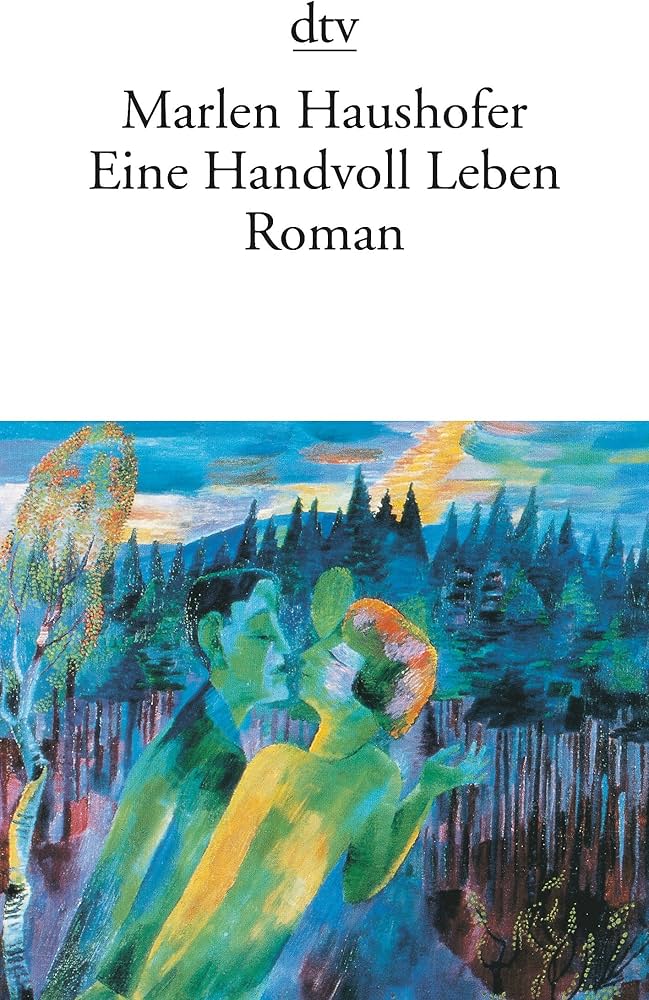
I have long loved Haushofer’s novel Die Wand, and I have been meaning to read more of her writing for a while – and I finally did. And the novel definitely was worth the wait, and that much was clear by the first page. Haushofer starts the novel by following Elisabeth’s son for a few pages, sketching out his life and the decision to sell the house. Those pages have a similar feeling as the prologue in Up for me, condensing so much into just a few short words that adds so much flavor to the story that follows, while also being tonally very different from the rest of the book (in this case: lighter, funnier).
When we get to Elisabeth’s own point-of-view, things really start when Elisabeth – who is staying in the guest room of the house while she makes the decision whether to buy it – happens upon a box of postcards and old photos. In fact, her own old postcards and photos that trigger her reflection of the life she led so far. Admittedly, this happenstance feels a little too unrealistic to really work, and there is even a moment where Elisabeth herself wonders about this chronologically ordered collection that just happens to be in the guest room. But I was able to look past it, and I’d urge you to do the same – it pays off.
Because Elisabeth’s story is one of sharp psychological insight, and beautifully written to boot. It is the first book in a long time that made me get out my pen to actually mark passages that touched me in one way or another. Elisabeth’s longing is so palpable and the characters are so vivid, they seem to leap off the page.
Above all, it is the story of a woman who keeps being told to erase herself somehow. For a while, she even does. But ultimately her will to be free to be herself is stronger than everything else – and she finds a way to freedom, though not without cost. She – who was never seen as who she is, only as who she was supposed to be – made herself invisible. Her disappearance gave her a chance to start over, a chance to set new terms. Those terms weren’t necessarily better, but they were her own. There is power in that story still, even 70 years later. It certainly had a hold on me.
Summarizing: great.
 kalafudra's Stuff