Project Hail Mary is a novel by Andy Weir.
Finished on: 12.2.2026
Plot:
An astronaut wakes up on a spaceship, disoriented and alone. His memories only return slowly to him as he figures out what his name is, how the spaceship works and what the hell he is doing hurtling through space in the first place. It soon becomes clear that it is up to him to find out how to protect earth from a catastrophic failure of its sun. But maybe he doesn’t have to find a solution all on his own.
I read The Martian a few years ago and was very much entertained by it. So, with the movie adaptation of Weir’s second book approaching, I thought that I’d give this one a try, too. And it was definitely a very enjoyable read again.
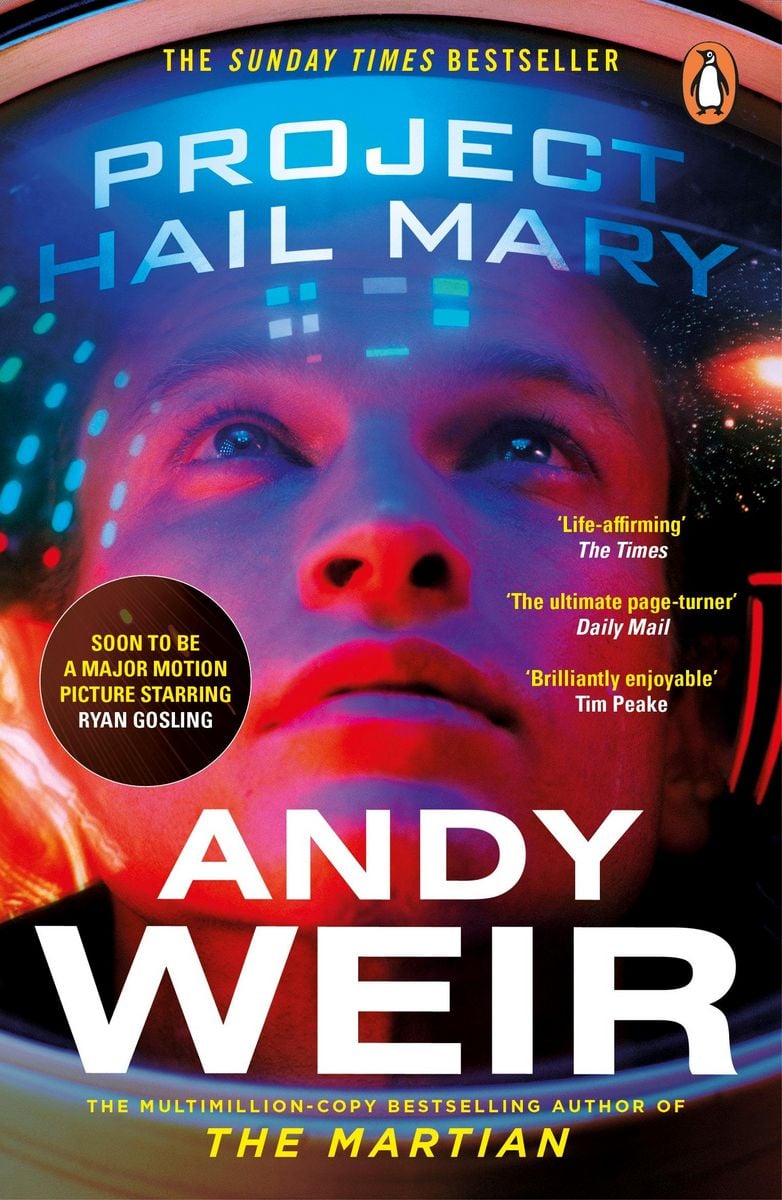
The Martian and Project Hail Mary feel similar enough that I feel confident that if you liked one, you’ll like the other. That is not to say that they tell the same story, but they are both stories about a lonely guy in space (though, in this case, not as lonely as in the Martian) doing a lot of physics to save his ass, and cracking jokes while he is at it. I have to admit that I was marginally less excited about Project Hail Mary, simply because it felt less surprising to me.
There were also moments where the problems Ryland solves seem a little convenient, narratively contrived for him to be able to solve them with the resources at hand, and the solution always very clear and right the first time (more or less). That being said, I still have basically no clue about physics, maybe that’s really how it works? I somehow doubt it, though.
In any case, I had a really good time with the novel, with Ryland’s narration and with the flashbacks we get to Earth that offers us a lot more and necessary context. Eva Stratt is an amazing character, too. And Rocky, of course. It was really fun to get to know him together with Ryland. (Allow me a moment of annoyance, though, for when Ryland acknowledges that he doesn’t know Rocky’s gender and couldn’t even say whether there is such a thing as gender with Rocky’s species, and thus decides to refer to him as „he“ as if the neutral „they“ wouldn’t have worked even better.)
As a thought experiment, I found both the problem posed and the way Earth goes about finding a solution really interesting. The latter does seem somewhat Utopian, given that climate change is almost as big a threat as astrophage here, and it still doesn’t make governments make it their priority, but it is nice to see what things could be like if they did. (Not that Stratt’s approach is without its ethical problems, far from it.)
In any case, I might not go looking for more of Weir’s books after having read this one, but I am definitely looking forward to the movie adaptation that is due out soon. It has all the right ingredients to become a good time.
Summarizing: good fun.
 kalafudra's Stuff