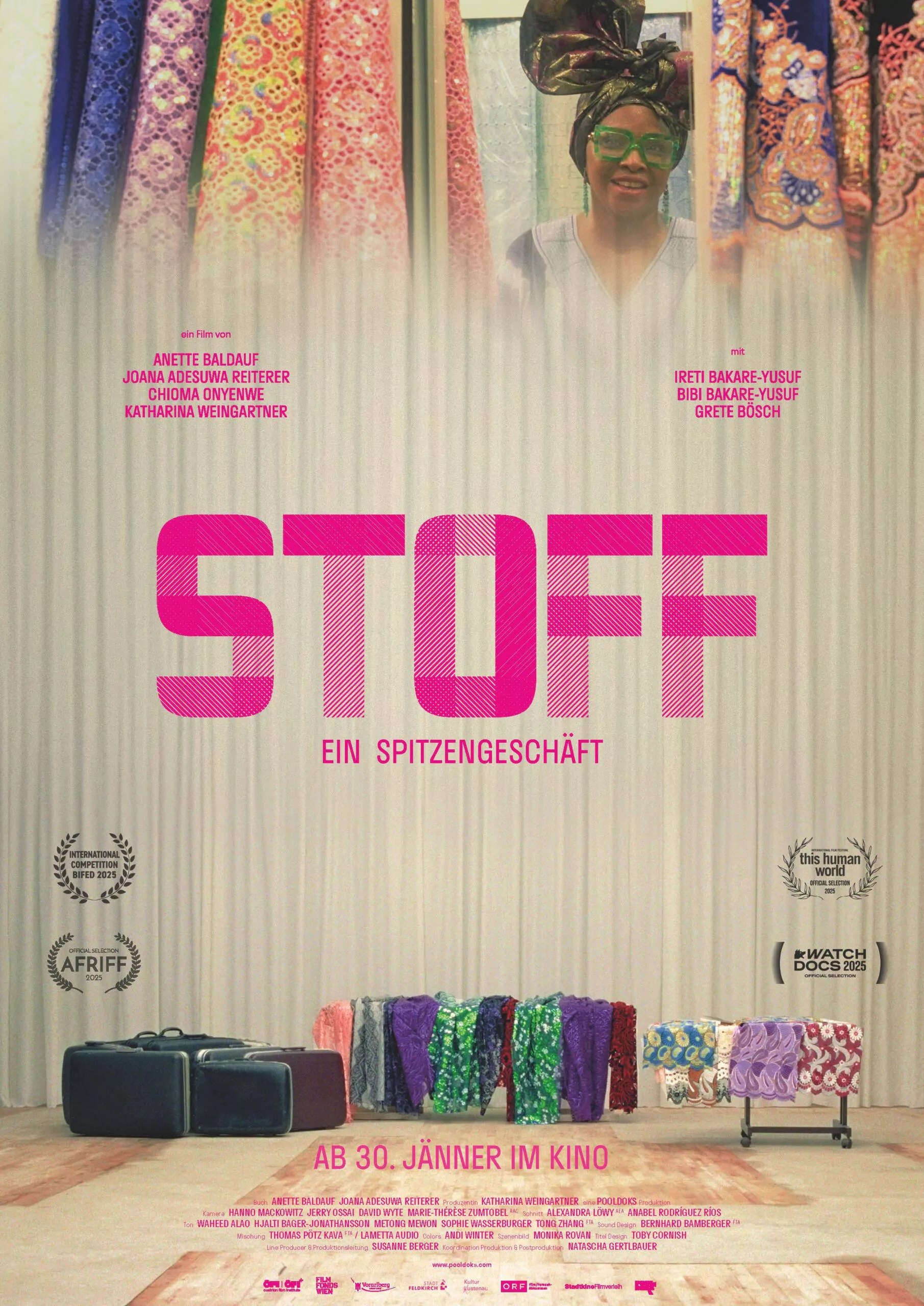
Stoff – ein Spitzengeschäft [literally: Fabric – A Top Business; but in German it’s also a pun on lace]
Director: Katharina Weingartner, Anette Baldauf, Joana Adesuwa Reiterer, Chioma Onyenwe
Seen on: 27.2.2026
„Plot“:
Margarethe Bösch used to work for an Austrian fabric producer who made a whole lot of money by exporting fabrics and lace to Nigeria, even after the import of fabrics was banned in Nigeria. Ireti and Bibi Bakare-Yusuf’s mother used to trade these fabrics in Lagos and made a name for herself that way. Reflectin on her career, Bösch wrote a tell-all book about the corruption she was a part of and is trying to spread the word. The Bakare-Yusufs meanwhile try to reconnect with their family history by coming to Austria.
Stoff makes some very interesting points and I definitely heard a lot of things for the first time. But the documentary was a little long-winded, I thought, and lost its steam along the way despite a short runtime.
To be honest, I had never really thought much about fabric at all, or where it’s produced and sold to. Since it is not a topic I am much interested in, I hadn’t really considered seeing this film but the (post-)colonial aspect of it did catch my eye in a preview and I figured, I’d give it a chance. So, there was definitely a lot to learn for me, starting with the fact that Austria is such a big exporter of fabric to Nigeria.
It’s also openly acknowledged by everybody in the film how corrupt this trade used to be in the 70s and 80s, after Nigeria banned the import of fabric to the country. Planes full of fabric flew to West Africa every week anyway, either to other countries or declared as „school books“, and suitcases full of money had to be smuggled out of the country as well. In a twist on the Western-centric narratives, we hear Bakare-Yusuf talking about how progressive Nigeria was compared to Austria at the time. At least in Nigeria, women could work and have their own money, opposed to Austrian women.

Even more interestingly (to me), the film draws the historic connection to the slave trade, showing that Austrian linen was brought to Africa and exchanged for slaves who were then brought to the Americas in exchange for cotton that was brought back to Austria. Austria’s participation in colonialist efforts in Africa are rarely talked about, and I really liked this part of the film.
But I was a little weirded out by the choice to have Bösch’s story told through a psycho-drama workshop. We are never introduced to the players involved, and the exact purpose of this workshop also isn’t made clear. I think, with a few tweaks, this idea could have worked, but it fell flat for me there, in stark contrast to Bakare-Yusuf’s exploration. Towards the end, I just couldn’t pay attention anymore and even nodded off for a few minutes. More could have been made with this, I think.

Summarizing: interesting, but flawed execution.
 kalafudra's Stuff