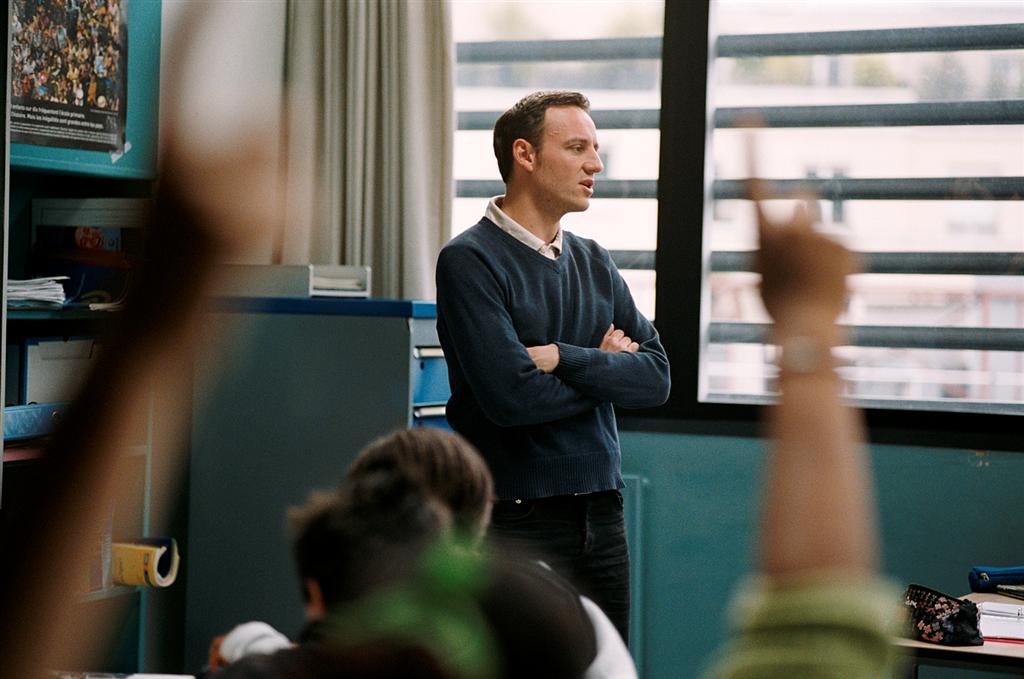
Entre les murs (aka The Class) is a fictional documentary or a fictional account of actual happenings or however you want to see it. Much of it is true, but it didn’t happen. It is based on the semi-autobiographical book by François Bégaudeau, who also played the main character/himself in the movie. The movie got the Palme d’Or in Cannes and is now nominated for best foreign language movie at the Oscars.
The film chronicles a year in one class in a French school. The school’s in the suburbs of Paris [I think], which are famous for their racial difficulties. These are also reflected in the movie, where there’s hardly one student, who was born in France.

It definitely is one hell of a impressive movie. The acting is impeccable. If I didn’t know that it wasn’t a documentary – hell, I would think it is. Everyone, from François Bégaudeau to his pupils gave everything and everything was more than enough.
The directing was perfect. As I said before, the movie feels like a documentary and it should feel like a documentary. Laurent Cantet captures it perfectly.
The story itself unfolds somewhat slowly, which is fine because we really see how fucked up the whole education system, the whole situation really is, before something happens that shows us the consequences of this fucked-up-ness. As such, Entre les murs is brilliant social commentary.
While I can’t find anything to fault, I left the cinema feeling very uneasy. Probably precisely because I couldn’t find anything to bitch about. It all just seems kinda hopeless: Change is needed, but where to start?
Not having the distraction to talk about cinematical failures, you really had to think about the issues. Which is uncomfortable. But also exactly the reason why everyone in touch with the education system [and who isn’t?] should watch this film.
 kalafudra's Stuff
I have been seeing the trailer for this movie for quite a while. And it looks quite interesting. Infact, I just saw a trailer for it yesterday before Waltz With Bashir.
Word.
@baph:
I can really only recommend it. How did you like Waltz with Bashir?
@deadra:
I take this as an agreement to what I said, but I’m not entirely sure. :)
@Kalafudra: I loved Waltz With Bashir. It was one of the most emotionally moving experiences for me at a cinema in a while. And to top it off – it was stylish, visually stunning, and very experimental in its narrative strategies.
p.s. although a small sequence in the end was a bit of an overkill.
@baph:
Seconded. Except for: Which sequence did you think overkill? I’m trying to remember one that I could have perceived as too much but I can’t come up with anything.
@kalafudra: The actual video footage. I didn’t need that emotional exploitation – thats the word…it was exploitative. It was a sort of insult- the assumption that the horror of the event would only come to us if we see the dead bodies.
To put it simply – remember the interview with the reporter where he says that after walking into the camp he saw a girl buried till her head, and that she reminded him of his own daughter. That was powerful enough. I was devastated. But did they have to show that in the end for real? Wasn’t that overkill?
@baph:
Interesting. I didn’t perceive it as exploitation at all. For me, it was just a reminder that those things really happen, that this is actually a documentary.
I mean, I was touched by all the accounts and interviews, but I’m also touched by completely fictional events. And having the movie animated gives us so much more excuse to distance ourselves from what happens. Having the real life footage is a way to break down those last defenses and telling us, “Even if it doesn’t look that way, this IS a documentary.”
No, I didn’t think it overkill at all.