Slowly, slowly, I’ll get all my reviews done. Because of my slight OCD, I decided that I’ll stick to the chronological order (at least mostly). We’re now at the end of June (the 20th, to be exact).
In June, there was still the Wiener Festwochen (Viennese Theater Festival). I already wrote about other productions I have seen, but this particular show was definitely the climax.
On to the actual review.
Othello is a play by William Shakespeare, for those of you who didn’t know. I saw the production by the LAByrinth Theatre Company, directed by Peter Sellars and starring Philip Seymour Hoffman, John Ortiz, Jessica Chastain and LeRoy McClain.
Plot:
When Iago (Philip Seymour Hoffman) doesn’t get the promotion he expected from his superior, Othello (John Ortiz), who happens to be black, but instead has to watch the younger Cassio (LeRoy McClain) getting promoted above him, he decides to have his revenge on Othello and Cassio. He uses the people around him to make Othello insanely jealous of his wife Desdemona (Jessica Chastain), he spins intrigue after intrigue and, as can be expected, things don’t end well.
The play is very good and the production was interesting. It was modernised, though they did stick to the original text. The acting was superb. But I did have some problems with some of the political messages Sellars wanted to send here. Still, it’s a super-special-awesome treat to just watch the cast and definitely worth the four and a half hours you spend in the theatre.
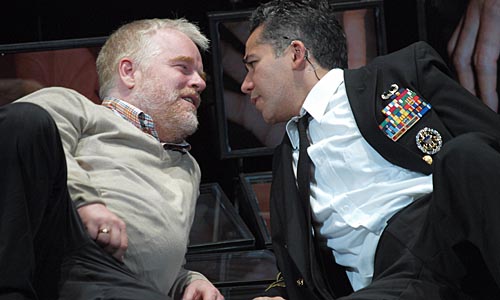
So, as I said before, the cast was absolutely amazing. Especially since most of them spent all the time on stage. There isn’t one I want to point out especially because it would be unfair to the others. They were really all great.
Okay, I lied. I have to point out two things: 1. Philip Seymour Hoffman’s Iago is not the evil henchman Iago often becomes. Rather, he’s tortured by his own decisions and instead of becoming a total brooding bore, PSH makes it work. 2. John Ortiz can be damn sexy when he wants to.
I also liked the stage design. It basically consisted of a few chairs and a huge bed made from TVs. The TVs showed different things, according to the mood. Unfortunately to find out what exactly they were showing and when, I would have to watch this play again since I couldn’t really focus on it. But I bet it’s all very thoroughly thought through and symbolic. ;)
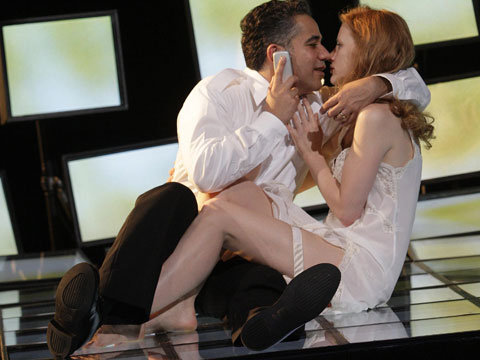
From everything you read about the production, Peter Sellars meant to make it political, in the contemporary context. This led to some very interesting choices, some of which work very well, others don’t.
For example, all of the cast are PoC, except for Iago and Desdemona. Interestingly enough, Othello is latino rather than black. [Does it matter in this case? I’m not sure. Some of the stereotypes about black people, and especially the ones of interest here, are the same for latinos – like the overhyped sexuality. But it makes things a little weird when everybody keeps harping about Othello’s blackness and he’s like one of the least dark people on stage.]
They fused the characters of Bianca and Montano into one (played by Saidah Arrika Ekulona), which I found was an awesome move. It deepens the relationship she has with Cassio and makes it more modern, showing that there are also women in the military.

But it also enabled the most disturbing thing in the whole play. In the play, there is a fight between Cassio and Montano. Iago makes Cassio drink, he gets riled up and finally they start hitting each other. Othello separates the fighters, blames them both and fires Cassio.
Now, in this production, Montano is female. So, of course, Cassio tries to rape her. It’s a sickening scene, which is okay, since rape is a sickening thing. But they didn’t change anything afterwards – Othello still blames them both, asking who started the whole thing. We’re still supposed to sympathise with poor, poor Cassio, who got hurt so much he can’t help but hurt the ones he loves.
But what takes the cherry is the following bit from the Rehearsal Diary by Avery T. Willis (dramaturgy), printed in the programme:
The rape itself is disturbing in its ambiguity – what is really happening, who started it, why doesn’t Iago help, did it really happen – but more importantly the aftermath that propels the plot of the play into a new realm of experience. Today it is unbelievably moving to witness both broken souls and their guardian angels, Emilia and the unlikely Iago. By the end of the play, when Montano is resurrected it feels to me a vindication of the assaulted Tailhook women who never really received their due justice. [emphasis and link mine]
First, let me say that there is no ambiguity: This rape is happening, the characters keep acting afterwards like it happened, there is no indication whatsoever that it was only a dreamsequence. And the question of who started it? He did, Cassio did, no doubt about that. No matter what Bianca might have said or done, he started to rape her. So fuck that.
And then, the so-called vindication? You know what happens in the end? Bianca forgives Cassio and they get back together. What kind of vindication is that??? What kind of due justice? I’m not saying that it never happens that rape victims forgive their rapists or that it isn’t a healthy thing to forgive and put things behind yourself and stuff. But you can forgive without getting back together. That’s an unhealthy thing to do. In any case, whether it’s realistic or healthy or not, it’s no vindication. Cassio is fired, but later reinstated, there is no punishment at all, in the end.
It’s more like a replay of the Tailhook scandal than them finally getting their due justice.
Honestly, if it wasn’t for this, I wouldn’t stop gushing about this play. But this subplot overshadows a lot and leaves a really bad taste in my mouth. Still, after 3 months.
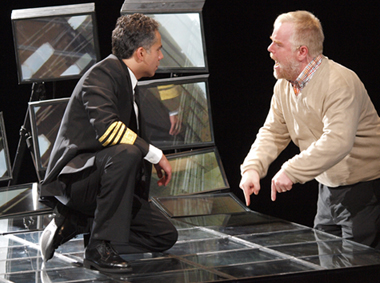
If you can overlook the whole rape thing, it’s awesome though.
 kalafudra's Stuff
[…] about race relations and since it was done many times already, people like to switch it around. The last time I saw it [if you don’t count the re-write I saw] (which was many years ago and still has one of the […]