Funny Games is an Austrian movie by writer/director Michael Haneke starring Susanne Lothar, Ulrich Mühe, Arno Frisch and Frank Giering which he then remade shot for shot ten years later with Naomi Watts, Tim Roth, Michael Pitt and Brady Corbet.
Plot:
A well-off family travels to their weekend getaway at the shore of a lake. While the father Georg(e) [Ulrich Mühe/Tim Roth] and the son get the boat ready, the mother Ann(a) [Susanne Lothar/Naomi Watts] stays in the house to prepare dinner. Suddenly a young man, Peter, [Frank Giering/Brady Corbet] comes from the neighbour’s house to ask for some eggs. He’s joined by another young man, Paul, [Arno Frisch/Michael Pitt] and while both of them are very polite, things become threatening really quickly. When the father and the son return to the house, Peter and Paul take the whole family hostage to play “games” with them.
Both movies are heavy cost – a thorough and deep analysis of violence in movies and what it does to the viewer. Haneke uses the horror genre conventions to hammer home a point – and hammer it he does. This is no subtle pointer that maybe violence in movies is not such a good thing but a huge, blinking neon sign that screams about the depravity of the average movie consumer.

[SPOILERS]
I watched both movies basically back to back (U.S. version first) because I was curious if I could find out how detailed a Haneke script is. Two things I have learned from this:
1: Don’t watch these two movies back to back if you are not completely stable and have either already lost all faith in humanity or have some magic formula to retain your faith. One of them is bad enough, but seeing the whole thing twice is soul shattering.
2: Haneke scripts are very detailed. But interestingly enough they detail other things than I would mention in a script of mine. For example, in the U.S. version pretty much everything’s white, not only the clothes of Peter and Paul, but also the complete interior design. So, as I’m personally a little obsessed with colour in movies, I figured this would have some significance. But in the Austrian version, only the two guys are dressed in white, the interior design isn’t. On the other hand, the entire layout of the house is completely identical – something I would have thought unnecessary.

After watching the first movie, I desperately needed a break. I felt like throwing up and crying. Just not knowing what to do first kept me from doing either. Seeing the second movie (sometimes I’m a mean bitch towards myself) was a little better. I don’t think it had anything to do with the quality of the films – honestly, all performances were great and other than that, nothing much had changed – but with knowing what to expect.
Because the thing about it is: Haneke doesn’t let the audience be an audience; he incorporates them into the film in the form of Paul. Paul, one of the perpetrators and the leader of the two, turns round in the middle of the film and winks at the viewer. I first I thought nothing much about it – it was a shock, being pulled out of the comfortable role for a second, but you quickly settle back into it.
And then Paul does it again. But this time, he talks to you, asks you about your expectations etc. And this time, you can’t just wave it away, can’t just pretend like nothing happened: you are forced to consider your own role in this. And you can feel the judgment, the nagging question: “Why would you watch such a movie in the first place?”

But the coup de grace is when Ann(a) manages to grab the gun and shoot Peter. Paul is thrown off for a second, searches for the remote control – and just hits the rewind button. The movie, obediently, rewinds.
Up until this point you might have still been able to kid yourself, but even the most unreflected movie goer surely most have felt the pressure Haneke built on the viewer at this point.
Because – or maybe despite – of this pressure, what I felt while watching the movie was not horror or even disgust, but desperation: Desperation that the family’s siuation was so completely chanceless, but even more desperation about us humans as a species who watch stuff like that as an entertainment [I’m not judging here, I watch these movies myself and I do enjoy them. (Even after Funny Games.)]. The conclusion of this film seems to be that we’re all completely fucked. [Which might be true, but do I really want to think about that?]
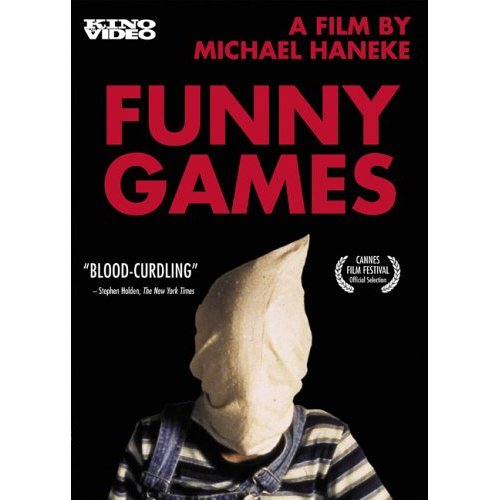
And Haneke manages to invoke all of this without showing us any act of violence directly. Contrary to what is usually the case, he only shows us the effects the violence has: The physical and emotional wounds.
So, if you want to be challenged – intellectually and as a movie goer – one of these two films will be perfect. Just make sure that you’re sufficiently anchored. But it’s definitely worth to give the movie a try and examine yourself in the course of it.
 kalafudra's Stuff
so… welchen fandest du besser? ^^
Schwer zu sagen… Ich hab die US version zuerst gesehen und dadurch war sie, glaub ich, ein bisschen eindrucksvoller. Weil ich noch nicht genau gewusst habe, was mich erwartet.
Aber ich war ehrlich gesagt überrascht von der Qualität der österreichischen Version. Das war echt ein guter Film.
[…] real, leaving you no way to flee to the safety of abstraction. In that sense, it is much like Funny Games from the feeling you get from […]
[…] also a nice look at (horror) movie audiences. Haneke might have made more succinct point in Funny Games, but Anguish has its own interesting […]
[…] we got leans more towards Funny Games instead, seemingly trying to bake a criticism of horror as a genre into a horror film. Only that in […]