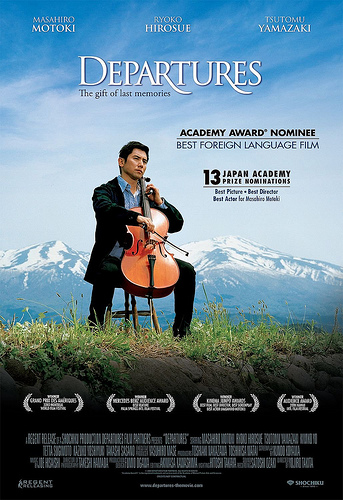
Okuribito is the Oscar winning Japanese movie by director Yôjirô Takita, starring Masahiro Motoki, Ryoko Hirosue and Tsutomu Yamazaki.
Plot:
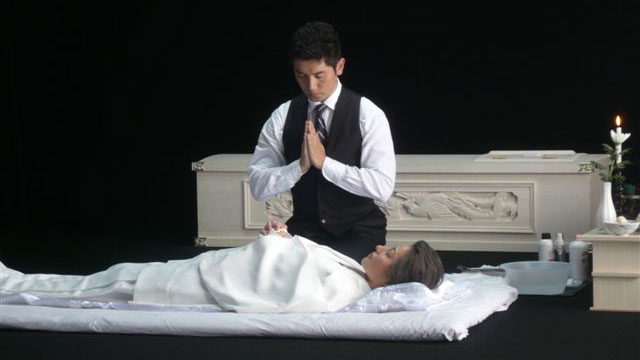
Daigo (Masahiro Motoki) plays cello in an orchestra, which unfortunately is only second rate and soon is closed. Out of desperation, Daigo and his wife Mika (Ryoko Hirosue) move back to Daigo’s hometown. Daigo stumbles upon an ad in the paper, offering a well-paid job you don’t need to have any experience for. Daigo applies and is promptly hired – only to find out that he now works for an undertaker, a profession hugely stigmatised in Japan.
Overall Okuribito was nice, but the story was predictable, the movie half an hour too long, some jokes were out of my comfort zone and I just didn’t think that the acting was particularly good. Even if it may sound like that right now, this is not a complete smashing of the movie.
[SPOILERS]
I don’t know a whole lot about the Japanese culture and I know even less about it when it comes to their relationship with death and undertakers but if it’s anything like what was shown in the movie, then it’s absofuckinglutely incredibly important that this movie was made.
After it’s “discovered” that Daigo works as a “undertaker” [for a lack of a better word] , he’s socially ostracized, his wife leaves him because he’s now “impure” and generally shitty behaviour ensues. And the movie shows the beauty and importance of these rites and that there’s nothing to be afraid of regarding the people who execute them.
But still, the movie has weaknesses – and a lot of them. As I said, the story is completely predictable and could have done without the whole father sub-plot (which would have also taken care of that superfluous half hour).*
Mika was, apparently, the stereotypical Japanese housewife. It seems that every Japanese movie has one of them: they work and then come home to prepare dinner and generally take care of the household, they’re always happy-go-lucky and annoyingly bubbly. Ryoko Hirosue does a lot with what little character she gets but that doesn’t change the fact that there’s just not a lot there.
Masahiro Motoki on the other hand had a lot to work with but it seemed to me that his acting partly descended into comic-like grimaces. [Now, this might totally be a cultural thing – every culture acts differently, also in the theatre or on film – but for somebody from Austria, it seemed ridiculous.]

Summarising: It’s a nice movie but a little overhyped and it’s importance might be lost in the cultural transition.
—
*Unfortunately this would probably have also meant the disappearance of my favourite part of the film: The stone letters. Beautiful idea.
 kalafudra's Stuff
I have a meme you might like on my blog (the privilege meme)
I’ve seen, done and scheduled – will be online next week.
[…] Rotten Tomatoes // Love HK Film // NY Press (negative) // Blow reviews: 1 // 2 aparoo says […]