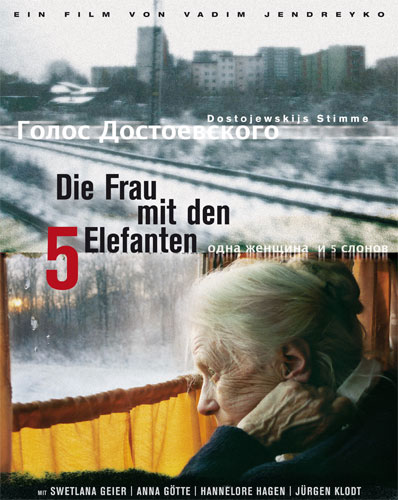
Die Frau mit den 5 Elefanten [The Woman with the 5 Elephants] is a documentary by Vadim Jendreyko about the translator Swetlana Geier [German].
Plot:
Swetlana Geier was born in Kiev, but left there when she was a young girl during WW2. She came to Germany and became a translator of Russian fiction into German. She’s most famous for her new translations of Dostoyevsky’s novels – the titular five elephants.
The movie is interesting, if a little unfocused and not quite the movie I expected to see. I expected a movie about the translation business and process and what I got was a movie about coming to terms with your past, especially the past of WW2.
Swetlana Geier had an interesting life. Her father was arrested during the Great Purge and was one of the few people to be actually released. Unfortunately, he died from the consequences of the torture he suffered there. Geier was 15 at the time and she took care of him until he died. When the Nazis came to the Ukraine, she managed to get a position as a translator, due to some coincidences and her good German. Through these connections she managed to escape to Germany in ’43, before the Russians took back Kiev. In Germany, she was lucky enough to get a job instead of being locked into a work camp and later went on to study at the university there.
The movie follows her on her first trip to the Ukraine since leaving almost 70 years ago.
As I said, her life is interesting and it was touching to see her confronting herself with her past, but I expected a different movie and I was slightly disappointed that I didn’t get it. This was even more emphasised because there are parts of the movie I expected in the film I got.

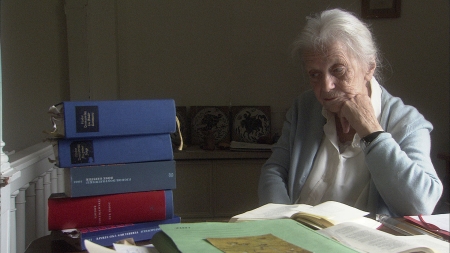
Of course, we get glimpses of Geier’s work as a translator. Her work process is fascinating: First, she reads and completely dissects the novel, until she knows the big structure by heart. Then she turns to the little pieces and prepares one each evening. The next day, a woman comes over who types (and corrects) the translation Geier reads to her. After they are done, a musician comes over who reads the translation to Geier and discusses with her some changes that he thinks should be made.
Not only is the process interesting, but Geier says a lot of intelligent things about language and translations and fiction – and those are the parts where the film really comes to life for me. Unfortunately, Jendreyko can’t decide what he actually wants to show – the professional Geier, or the private one and he ends up leaving us unsatisfied on both accounts.
Summarising: Despite the shortcomings of the film, it is still an interesting look at a fascinating person.
 kalafudra's Stuff
sounds interesting.