Los hongos (literally translates to “the Mushrooms”, apparently)
Director: Oscar Ruiz Navia
Writer: Oscar Ruiz Navia
Cast: Jovan Alexis Marquinez, Calvin Buenaventura, Atala Estrada, Gustavo Ruiz Montoya, María Elvira Solis
Part of: Viennale
Plot:
Ras (Jovan Alexis Marquinez) and Calvin (Calvin Buenaventura) move through the streets of Bogota, always looking for paint and walls to apply that paint on. Both aren’t easy to come by as neither of them has any money and street art is illegal. When an opportunity presents itself to work with some of the most famous street artists in Colombia on a joint mural, they start conceptualizing their part with enthusiasm, wanting to combine political messages and art. But such a mural isn’t easily done.
Los hongos tells an interesting, very political story that gives the impression that you really get a good window in that slice of Colombian life, but left me with a very unclear take-away.

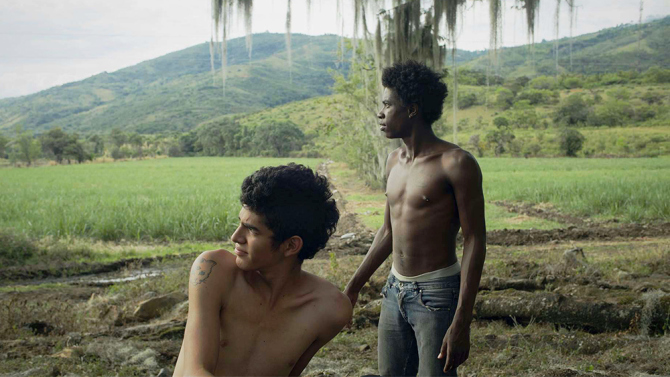
I really loved that they didn’t forget the ultimately very political dimension of street art, whether it’s overt political slogans or “just” tagging, and used it as the starting point for a portrayal of the political climate in Colombia at the moment. The film itself becomes quite lyrical as well, especially towards the end when Ras and Calvin find themselves outside of the city – where many things that were shown inside the city were mirrored – like the youth of Calvin’s grandma, the underwater mural, the tree of course and even the cow.
But that rather impressionistic ending was also the part where I was stumped. I didn’t know what the film was trying to tell me (and I always believe that films are communications): that humans are inspired by nature? That nature is missing in modern city life and we have to make do with smaller, somehow lesser copies? Something else entirely? I don’t know.
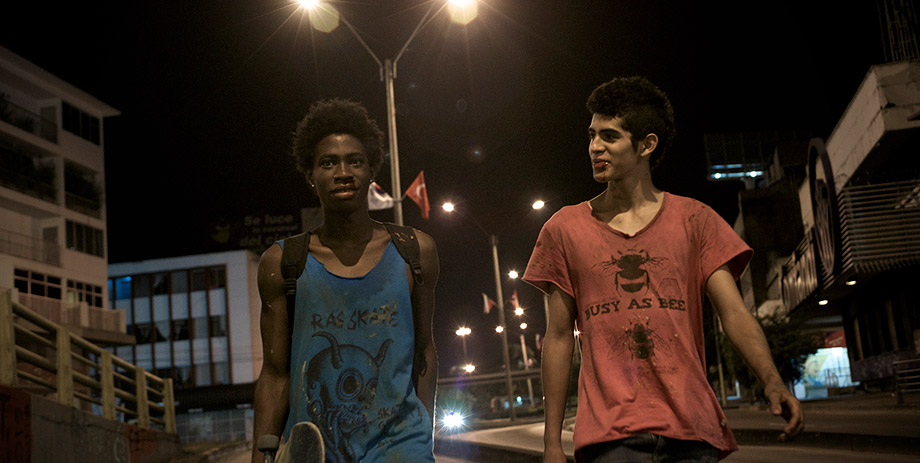
But the vagueness of the ending wasn’t that important. The film is a good watch despite – or maybe because – of it, with many great details (how I loved the grandma’s house!) and two interesting, well-acted main characters*.
For once, the young, poor men doing street art are not hoodlums or romanticized artists, but just normal kids doing their best to live their lives as they want it. I liked it.
 Summarizing: Good, but not great.
—
*Apparently there is something inherently funny about a (black?) young, male graffiti artist referring to a feminist message and idols – because my audience laughed at that and there was no joke as far as I could see. But that has nothing to do with the film – in fact, I appreciated that inclusion.
 kalafudra's Stuff