55 Steps
Director: Bille August
Writer: Mark Bruce Rosin
Cast: Helena Bonham Carter, Hilary Swank, Tim Plester, Jeffrey Tambor, Richard Riddell, Johan Heldenbergh
Seen on: 11.5.2018
Plot:
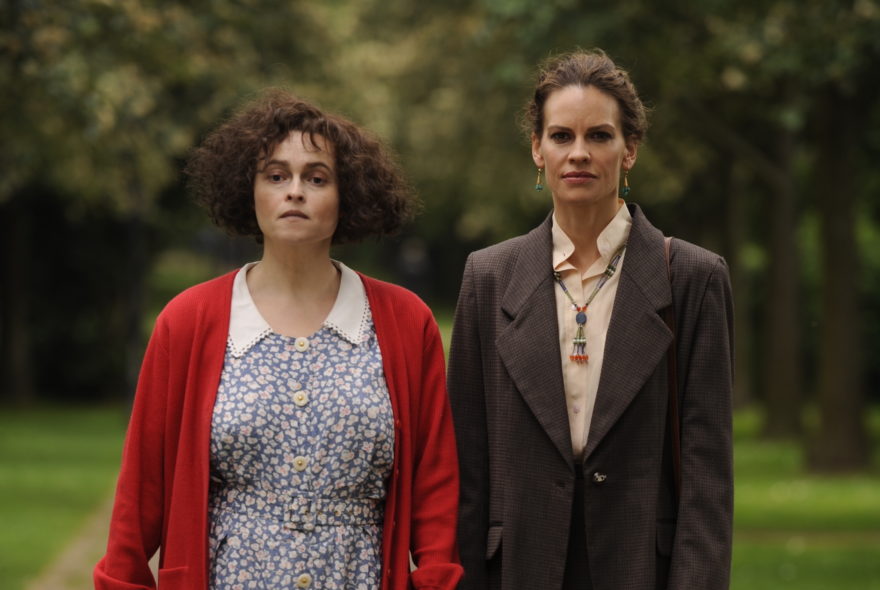
Eleanor Riese (Helena Bonham Carter) has been in and out of psychiatric facilities for most of her life, so she is intimately aware of what is going wrong there. And what it boils down to that people believe that being in need of psychiatric help means that one can no longer be trusted to make decisions about one’s own treatment. Eleanor really doesn’t think so – and she’s willing to sue the hospital for it. With the help of her new lawyer Colette Hughes (Hilary Swank), she takes up the fight for psychiatric patients everywhere.
55 Steps is probably a nice crash course for the patients’ rights movement. It is an enjoyable film – apart from the catastrophic casting decisions made.

When I say that the casting here is a catastrophe, it’s not because Bonham Carter and Swank don’t act well. They are good actresses, giving good performances. But it is absolutely egregious to see a thin, abled person playing a fat, disabled person and it’s not something that’s cute or great or shows off acting skills – it’s a stolen opportunity from a fat, disabled actress. And that’s not even the only misstep the film makes regarding casting: as it turns out, Colette is Native American, an identity that the film emphasized over and over again. Swank is not Native American. She’s a white person putting on brown-face and stealing a role from a Native American actress. That shit simply doesn’t fly and everybody should be aware of that by now.
I can completely understand why you’d choose not to watch this film, just based on these facts. I decided to go for it anyway because I was hoping that the film would transcend its casting choices and be at least a good piece of advocacy for disabled people. While it does get close to inspiration porn (and sometimes even crosses the line), I do think that they do make good points and may bring the topic of patients’ rights closer to people who haven’t thought much about it until now.

I would have loved it though, if they had tied it much more radically to the way things are in psychiatric facilities nowadays. Of course, a lot has changed in the last thirty years, and changed for the better, but there’s still a lot that’s not good and not how it should be. Making clear that the issues are not a thing of the past, would have strengthened the film.
The film does manage to be emotional and I definitely wasn’t bored. But I would have had much more confidence in the film, its intentions and its execution if it hadn’t made such basic mistakes in the casting.
Summarizing: Mixed.
 kalafudra's Stuff
It really stood out to me that Hilary Swank in this film is appearing to be a white woman playing a Native American character which seems crazy, awkward and offensive in this day and age, so I looked her up and I don’t know if this helps you to know but apparently Hilary Swank’s grandmother was Native American.
And yes despite Helena Bonham Carter’s excellent performance, I did note (being disabled myself) that she’s an able bodied person playing a disabled person. That’s nothing new and seems to be a very slow thing to change in the industry, but given this story highlights people’s autonomy it could’ve done much more in that space. However of course Bonham Carter would’ve been a big reason many people saw the film and in doing so learned the story, so there’s that I guess. All that aside, I was still very personally touched by it and by her performance, as well as the knowledge that good people are out there striving for the wellbeing of others like these two lawyers and their brave clients. And I still cried
That is true, cripping up is a big problem that I myself also only became more aware of in recent years.
But a story or representation being problematic doesn’t necessarily mean that we can’t be touched by it, that is for sure!