Black Christmas
Director: Sophia Takal
Writer: Sophia Takal, April Wolfe
Remake of: Black Christmas (1974)
Cast: Imogen Poots, Aleyse Shannon, Lily Donoghue, Brittany O’Grady, Caleb Eberhardt, Cary Elwes, Madeleine Adams
Seen on: 13.12.2019
Content Note: rape, sexualized assault
Plot:
Christmas break is approaching and Hawthorne college has mostly emptied of students. Riley (Imogen Poots), Kris (Aleyse Shannon), Marty (Lily Donoghue), Jesse (Brittany O’Grady), and Helena (Madeleine Adams) are sorority sisters who have remained on campus for now. They are preparing to go to a fraternity talent show, despite the fact that Riley was raped by one of them and that Kris has run afowl the boys’ club at the university with her feminist activism. But sexism and rape culture are not the only threat to women at Hawthorne: there is also a killer going after the girls.
Black Christmas is an openly feminist retelling of a beloved slasher classic, reinterpreting a genre that is usually more interested in killing the women than in exploring them as characters. I really enjoyed it.
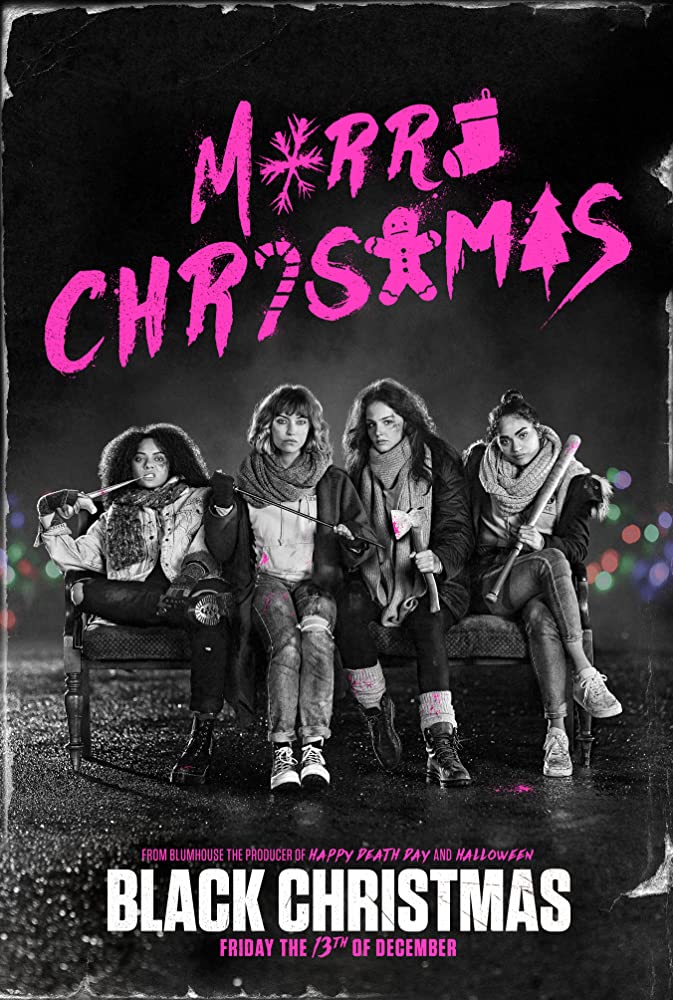
Black Christmas takes the misogynistic subtext that saturates our society and makes it very explicit. There is no subtlety here: the film takes away the usual veneer that makes misogyny socially acceptable. That is a bold move because it could be argued that it is overly didactic, but it works beautifully. And I know that people really do need this shit spelled out, so it is quite simply necessary. And it was quite refreshing to see a film where you don’t have to look for the feminist subtext with a magnifying glass. It’s there, in your face.
The film never loses its sense of humor about it, though. This is a slasher film after all and more often than not (at least since Scream), they come with a sense of irony. That is also the case here. At times the film does get a bit cheesy, but I’d attribute that, too, to the genre. That the girls are effectively fighting back goes against genre conventions, but that’s also what makes it so great.

The cast is great, especiallys the central foursome Poots, Shannon, Donoghue and O’Grady. They ground the film emotionally, even when it takes a couple of outlandish turns (but always connected to reality). It was easy to root for them, and get distressed with them, and rejoice with them. Let’s fight patriarchy together!
All of this makes Black Christmas really stand out, and I do hope that the film finds its audience, despite the abysmal ratings it got. It definitely doesn’t deserve them, if you ask me.

Summarizing: a feminist slasher – what’s not to love?
 kalafudra's Stuff