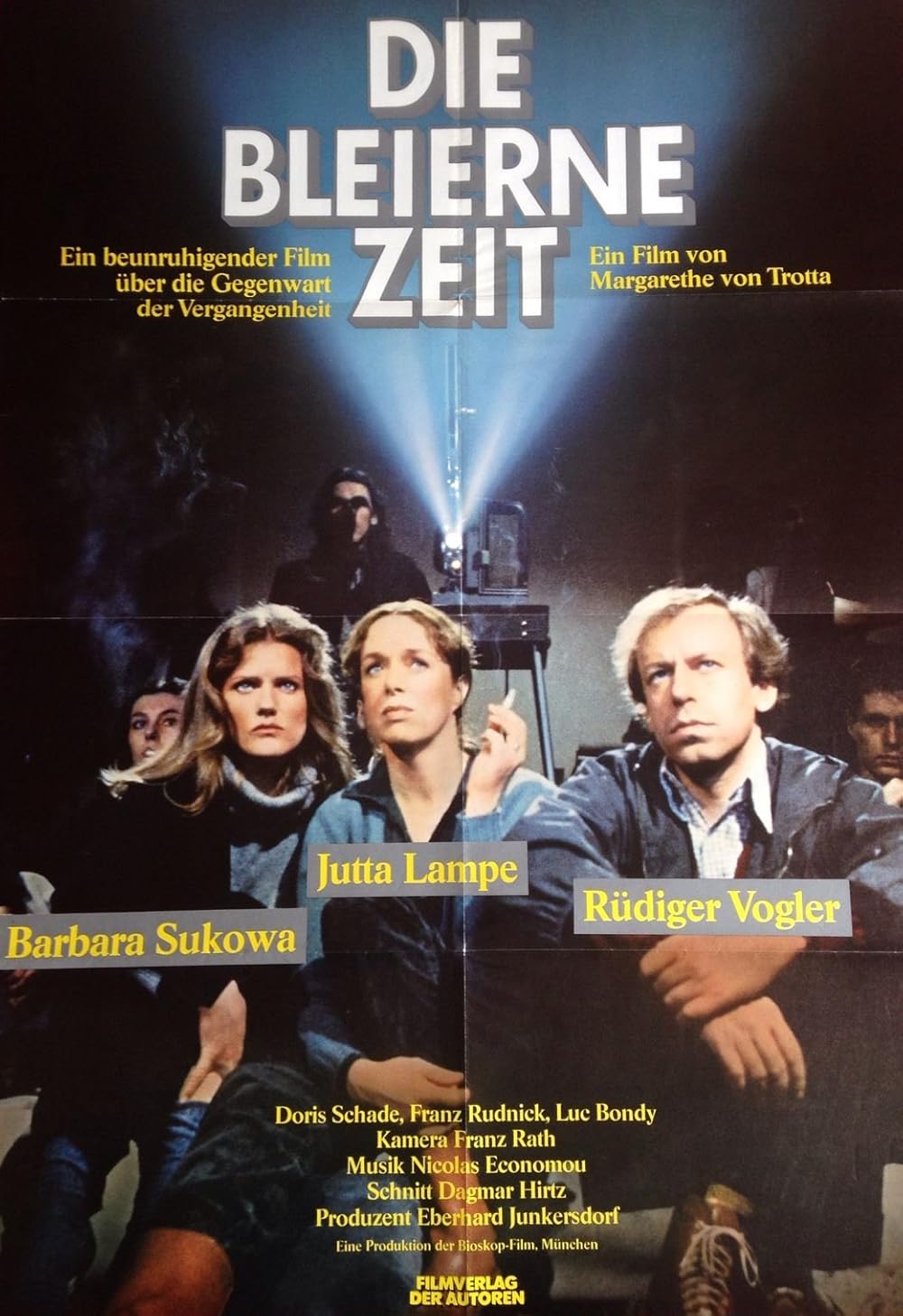
Die bleierne Zeit [literally: The Leaden Time]
Director: Margarethe von Trotta
Writer: Margarethe von Trotta
Cast: Jutta Lampe, Barbara Sukowa, Rüdiger Vogler, Doris Schade, Vérénice Rudolph, Luc Bondy, Franz Rudnick, Julia Biedermann, Ina Robinski
Seen on: 8./9.1.2025
Plot:
Juliane (Jutta Lampe) and Marianne (Barbara Sukowa) have both devoted their lives to politics, but in very different ways. While Juliane is a respected feminist journalist, Marianne has joined an illegal organisation that engages in terrorism. That’s also why Juliane has been tasked with taking care of Marianne’s son. Marianne has been on the run for a while, but the law finally catches up to her. After her arrest, Juliane tries to reconnect with Marianne in prison.
Die bleierne Zeit uses a very specific political context to shed light on sisterhood, and vice versa. With fantastic performances and a thoughtful approach, it is still a powerful film.
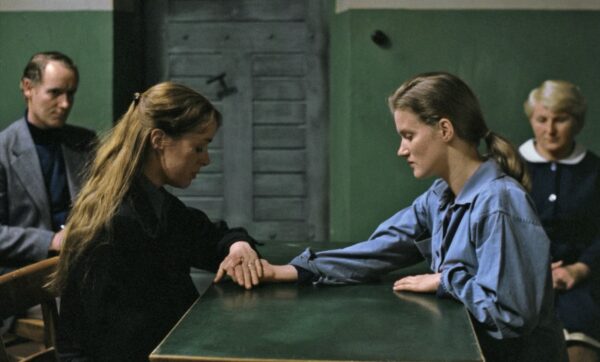
It is no coincidence that von Trotta set her story in the 60s and 70s. Juliane and Marianne grew up in the „leaden time“ of silence after the Second World War, where German society tried to forget by just never speaking of the holocaust and everything else that happened in WW2. von Trotta captures the girls‘ childhood under these circumstances, and the radicalizing effect seeing images of the concentration camps had on them in a few strong flashbacks.
The film is inspired by the real history of sisters Christiane and Gudrun Ensslin, but it is no biography. The real history is a starting point for the film to examine the politics of the time. But maybe even more so, it wants to examine sisterhood and uses politics to do so. We learn where Marianne and Juliane differ, but even more how they are alike.
There is a subplot in the film that involves Marianne’s son that was at the heart of the film for me. At first, history risks repeating itself with him. Nobody really talks to him, and in fact, he is a disturbance in both his mother’s and his aunt’s life. To me, this mirrors the silence Julane and Marianne experienced from their own parents in its refusal to come near, to actually have a relationship with each other. But at the end of the film, an actual dialogue starts to happen with him.
Lampe and Sukowa gives us excellent and sensitive portrayals of two brusque, tough women who have learned how to fight but not really to take care. They bring their characters to life and make the movie more than an intellectual exercise, but a living, breathing thing that still has something to say.
Summarizing: very good.
 kalafudra's Stuff