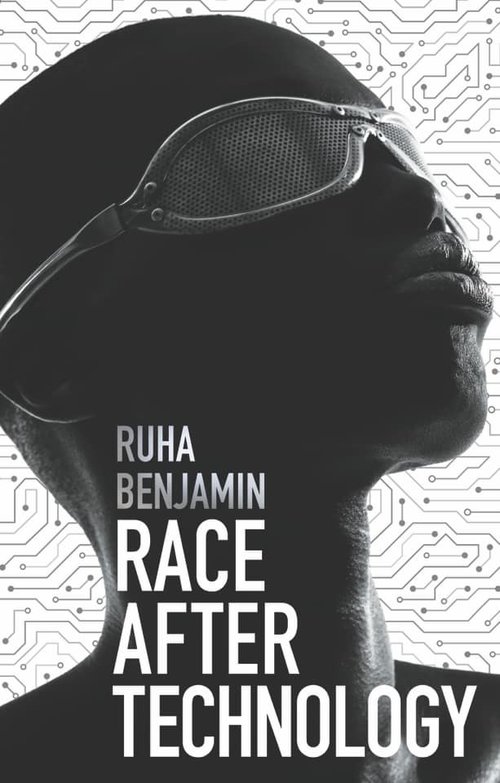
Race After Technology: Abolitionist Tools for the New Jim Code is a non-fiction book by Ruha Benjamin.
Finished on: 1.2.2025
Content Note: (critical treatment of) racism
“Plot”:
Benjamin looks at new technologies to understand how they don’t neutralize (racial) discrimination and bias, but exacerbate them instead. Understanding race itself as a social technology, she shows how other technologies – from apps to algorithms – actually incorporate race into their own programming, creating what she calls the New Jim Code. With this analysis, she also presents ways how to recognize the contradictory mechanisms behind technological promises.
I’ve read a couple of books on the topic of algorithms and how they further inequality instead of reduce it, as many people would like to think (like Weapons of Math Destruction or Automating Inequality). Race After Technology works along a similar vein but with a specific focus on race and was therefore an excellent addition to my own little study project.
I have a tendency to see the patterns things have in common, so a lot of the mechanisms Benjamin describes didn’t come as a surprise to me. If algorithms replicate and strengthen inequality based on class or gender, of course they will do the same for inequalities based on race. But at the same time, the specifics differ – and those differences matter, too. That’s why I still found Race After Technology an enlightening read.
Benjamin has a knack for connecting historic examples of racism and „race science“ to modern technologies, showing how often the seemingly innovative is just a continuation of the old, traditional injustices wrapped in a new coat. As such, the book is not just an excellent analysis of the status quo, but also an interesting histriography.
But what stood out to me the most, I think, is Benjamin’s way of understanding race itself as a (social) technology. Moving away from understanding it as a category to a technology, it underscores the what-for of the distinction between races, that it serves a purpose. That purpose being a redistribution of power away from People of Color towards white people. And it underscores that it is a permanent (and not uncomplicated) process that leads to said distinction. In short, it is work to maintain the distinction, work done by all of us.
Race After Technology was published in 2019, so just a few years before the „AI“ hype (it’s not really AI, it is Machine Learning, it is algorithms with a fancy hat). I would like to see a „sequel“ or an expanded edition of the book that looks at all the fanciful rhetoric that surrounds this particular technology and the outputs it creates. But I can imagine what that book would say: that it is more of the same, racism that pretends to be science above and beyond the real world it comes from.
Summarizing: can recommend.
 kalafudra's Stuff