Fritz Riemann was a German psychoanalyst. He wrote several books on psychoanalysis and astrology (of all things…) and one of these books is Grundformen der Angst [German], which translates to the Basic Forms of Fear.
In it, Riemann develops a personality typology based on the notion that there are four conflicting needs in every person and each need goes hand in hand with a fear. On the one side, the need to be an individual (fear of love and commitment) and the need to be part of a group (fear of loneliness and self-actualisation), on the other side the need for constancy (fear of insecurity and change) and the need for change (fear of confinement and constancy). He says that in a healthy human, these four needs – and the fears that come with them – are balanced and everybody experiences all four forms.
But if one of the four types gets out of hands, gets more weight than the others, this causes one of the following four disease patterns: schizoid (fear of commitment), depressive (fear of self-actualisation), compulsive (fear of change) and hysterical (fear of constancy).
The book describes these disease patterns and gives examples from real life.
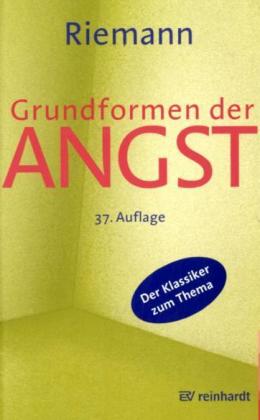
It’s an interesting and fortunately not too rigid typology. Riemann writes well and its easy to understand the whole book.
But he also can’t deny that he’s an old-school psychoanalyst (not that he wanted to) with all that comes with it – interesting insights but also overly focussed on men, treating women mostly as if they didn’t exist, unless they’re mothers, because everything’s the mother’s fault and in the end it all comes down to sex (basically every of the four typologies makes you homosexual, for example).
The book was first written in the 60s, although it was kept up to date by Riemann until his death, it’s a little outdated. Especially when it comes to questions of gender.
He also has some interesting thoughts on religion and atheism, which I’d definitely dispute. And he was very interested in astrology and that seeps in as well. [I don’t know how he was interested in astrology – whether he believed in horoscopes (which I personally think is crazy) or whether he thought that the description of the zodiac signs is a rather early personality typology which actually has nothing to do with when you were born (with which I could get onboard).]
But there’s definitely a truth to the whole thing and more than once it had me seeing myself (and friends) in the descriptions Riemann gives. Which is of course especially charming because he describes mentally unhealthy people. [In case you wondered, I’m pretty balanced on the compulsive-hysterical axis, but on the schizoid-depressive axis I keep on changing extremes.]
Anyways, as usual, typologies should be taken with a grain of salt, but it was definitely fun to analyse my whole family in the course of the weekend when I read the book. (A hint for anybody who wants to pick this up: Take more time than a weekend to read it because you’ll be going absolutely crazy otherwise. I’m telling you, after finishing the book, all I could think about where these categories and how my mom did and didn’t mess me up and wonder about why I’m not homosexual and and and. Not enough breathing time. It’s okay now.)
Well. If you want to, I could explain the four types in more detail. Just ask. :) Be warned though… I can’t guarantee your sanity afterwards, as little as I can guarantee my own.
 kalafudra's Stuff
quote:”… and more than once it had me seeing myself (and friends) in the descriptions Riemann gives.”
I know this from other characterisation-theories. It’s unnerving to find 9 out of 10 suicidal pattern in a person close to you. Or wondering about how deviant/narcistic/whatever you could be. And your friend. And your other friend.
Exactly. And it was very, very unnerving when Riemann describes what signs you should look for in a child if it is in danger to become schizoid – and he perfectly describes my youth. I read this part to my parents and they started laughing before I was even halfway through. My brother passed by while I was reading this and said, “hey, they could be talking about you!”
But at least I’m not suicidal. ;)
… guess who makes far too many border-line potential judging from her childhood ;)
but don’t worry *hehe*
Psychology of the 60ies is so focused on men (who are far more likely than women to develop any illness, mental or not) that we can relax a little. ;)
Psychology of the 60s? I’d say all of psychology up till today, plus all of medicine. That’s only slowly starting to change.
But anyways… you’re a borderliner, huh? ;)
Your explanation/synopsis of Riemann’s Basic Fears is much much better than what is currently on Wikipedia in English. Here’s the link of you want to help them clean up their references and explanations. :)
http://en.wikipedia.org/wiki/Fritz_Riemann_%28psychologist%29
Thanks!
I cleaned up the explanation of the basic fears. Unfortunately I can’t really help with the references. But at least, it’s understandable now, I think. ;)
Thank you for your tribute to Riemann’s “Basic forms of fear”. Fortunately, it has been translated and published in Bulgarian, which gave me a chance to read this remarkable book. As you have mentioned before – the model is streamlined and simple, yet has very high predictive power. I would recommend this book to anyone.