Todespolka [Polka of Death] is an Austrian movie by Michael Pfeifenberger, written by Stephan Demmelbauer and starring Stefano Bernadin, Viviane Bartsch, David Wurawa, Tamara Stern and Alexander Pschill.
Plot:
Austria, in the very near future: the last elections have brought Austria a radically right prime minister, Siglinde Führer (Tamara Stern). Now, Austria is out of the EU, has got the Schilling back and is about to re-introduce the death penalty and basically making itself into a totalitarian state.
Most of the people are happy with her but some find the development worrying. One of the latter group is Raphael (Stefano Bernadin), a medical student. His best friend Michael (David Wurawa), another medical student, is black and therefore in the target group of the hate attacks. But both Michael and Raphael remain convinced that they are safe – they are doing nothing wrong, aren’t they?
Unfortunately, that’s not how mobs work…
Todespolka starts off with an interesting idea, but unfortunately the writing isn’t up to the challenges. The characters remain one-dimensional at best and I could have told you the ending after the first five minutes of the movie.
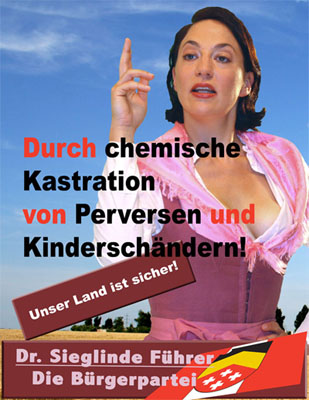 [Translation: Through chemical castration of perverts and pedophiles! Our country is safe!]
There are a few things the movie gets right: The poster campaign (see above) is very well executed. It was also great to have a black guy in an Austrian movie (I honestly don’t think that I have seen that before. Because there are only white, blue-eyed people in Austria. ahem), even if his role basically came down to being a trigger for other events, only marginally related to his character.
Unfortunately, it also does a lot of things wrong. All women, for example, are either hags or whores (figuratively and literally) with the exception of one daughter, who is basically a servant, and one dying mother. But where it trips itself up the most is the writing.
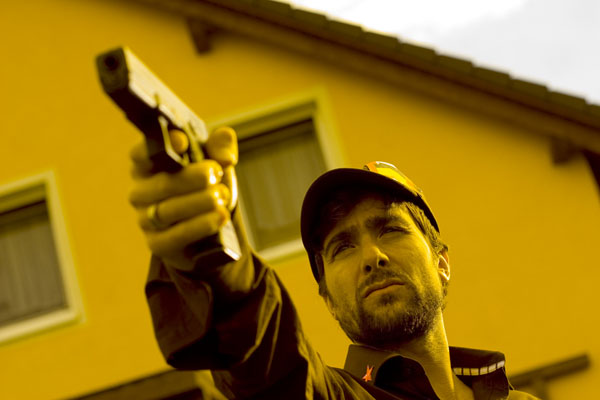
In the hands of a more talented writer, the cast might have actually had something to work with. As it was, Alexander Pschill and David Wurawa stood out because they both have charisma and they managed to wrangle some emotions out of their stereotyped characters.
And the plot was just so clear; right from the beginning you knew how it would end. There wasn’t even a little bit of doubt on my part. And that is just sad.

Summarising: Even though I always feel bad giving bad reviews to Austrian indie movies, I can’t honestly recommend this one.
 kalafudra's Stuff
This sort of story is usually supposed to have a predictable plot, isn’t it? The only way they ever make them good is by having quotable lines/speeches/whatever. And doing them well, of course.
The poster is actually quite scary.
Well, there’s predictable as in “that’s not going to end well” and there’s predictable in “first that, then that and afterwards this is going to happen”.
Todespolka falls into the second category.
Is this “The wave” for grown-ups?
Not really. But then again, it bears a lot of resemblance.
Hello Kalafudra
Austria’s political culture has undergone an unparalleled decline since 1986.
Demagogic, xenophobic slogans are now socially acceptable (“At home, not Islam,” the demand for “Western lands in Christian hands”), and compared to his imitators, Jörg Haider has come to represent a relatively moderate political style, and not only since his demise.
My intention was to take this coarsening to its logical conclusion. Political rhetoric has always had long-term affects, including on peoples’ daily lives. What politicians say to fire up the crowds at election rallies can ultimately lead to outbreaks of violence.
Making all the radical possibilities this can entail comprehensible, to a broad audience also, was the intention behind the “Todespolka” project.
The film develops in a linear and slow, typically Austrian fashion, and the stylistic elements employed are intentionally simplistic. The majority of the monologues and dialogues were taken, with few alterations, from discussions at bars, political rallies and letters to the editor of the country’s leading tabloid. No effort was made to package this material subtly, because the film was not intended for film experts alone.
Tension is created precisely because the viewer knows subconsciously how everything will turn out, but doesn’t want it to happen.
The film’s relevance for all other European countries was shown recently by the election in Holland.
Best wishes from Vienna
Stephan Demmelbauer
You might not have ventured far enough into the blog to know that I’m actually Austrian – and trust me that I know about the political situation here; and that it worries me a lot.
I saw and appreciate your intentions with the film. I also think that it succeeded pretty well as a political statement. It only succeeded less as a film.
The problem with political movies is that they have a double function; being political and being entertaining. Unfortunately, Todespolka fell a little flat in the latter category.