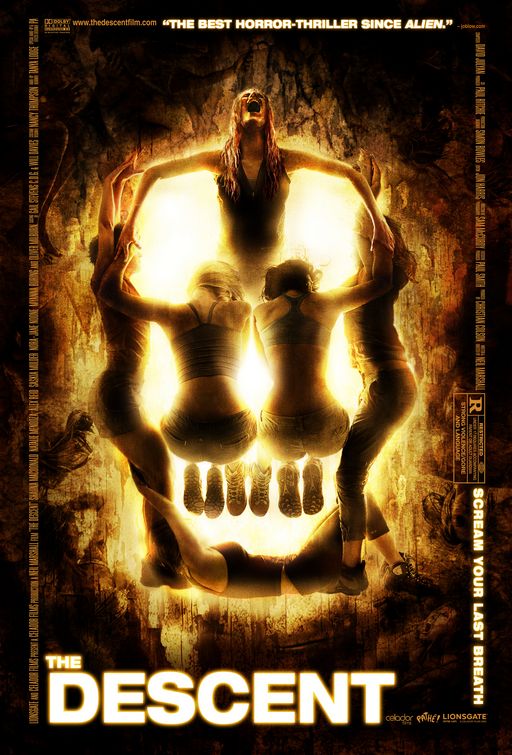
The Descent
Director: Neil Marshall
Writer: Neil Marshall
Cast: Shauna Macdonald, Natalie Mendoza, Alex Reid, Saskia Mulder, MyAnna Buring, Nora-Jane Noone
Seen on: 27.03.2015
[Here’s my first review.]
Plot:
A year after a tragic accident in which her husband and daughter died, Sarah (Shauna Macdonald) catches up with her girlfriends for a weekend of caving. But as soon as they get down into the cave system, things start to go wrong: a part collapses and blocks them from getting back the way they got in. It turns out that they’re not in the explored caves they thought they were. And there is something in the dark.
When I watched The Descent for the first time, I was quite taken with the atmosphere but above all with the characters and the portrayal of female friendships. On re-watching I feel like I have to take back some of my accolades.
[SPOILERS]
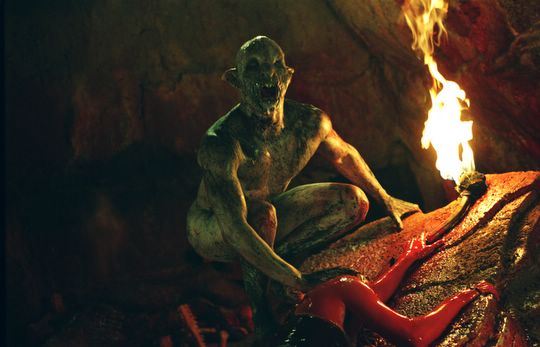
Even on re-watching it, The Descent proves to be an atmospheric, creepy film that racks up the tension and always manages to one up what has happened before (even though I did have a little more difficulty suspending my disbelief this time when it came to the monsters at the end). That part of the film I enjoyed and won’t retract my earlier opinion of.
But the part that I loved most the first time around – that there is a group of women who are competent and adventurous and have complicated, but supportive relationships with each other, a group that is never damselled or sexualized – is also the part that I had to critically re-evaluate the most on second viewing. I mean, all of that is still true. But it’s not that simple and not that purely positive.
 For one, racially speaking there is a bit of an issue here. The only woman of color – Juno (Natalie Mendoza) also happens to be the one who had an affair with Sarah’s husband and who is now sleeping with a woman, Holly (Nora-Jane Noone). On the one hand, bisexual representation, yay! On the other hand, it makes her the most sexual character in the film and the most untrustworthy one. With a cultural narrative surrounding non-white female bodies that exoticizes and fetishizes them, while making it clear that they don’t have any morals to speak of, that was really something that I could have done without. Plus, it also reinforces the notion that friendships between women can’t possibly be loyal, that they’re always under threat because of men and sex.
The depressing ending where nobody gets away also underscores that while these women may be inventive, clever and brave and thus stand the best chance of getting away from the creatures, it is still not enough to escape the cave. A cave populated by creatures that appear to be mostly (though not exclusively) male. This begs the questions: Would it have been any different if there had been a guy with them? Would there have been a final girl?
Both these things undermine the feminist reading I saw in the film the first time around, which ultimately led to me being disappointed.
 Summarizing: Maybe if I see it a third time, I will like it better again.
 kalafudra's Stuff