Das radikal Böse
Director: Stefan Ruzowitzky
Writer: Stefan Ruzowitzky
Cast: Devid Striesow, Benno Fürmann, Alexander Fehling, Volker Bruch, Simon Schwarz
Interviewees: Roy Baumeister, Robert Jay Lifton, Christopher Browning, Patrick Desbois, Benjamin B. Ferencz, Dave Grossman
Plot:
Radical Evil is a documentary about the mass shootings in Eastern Europe during WWII, where about two million Jewish civilians were killed – by completely “normal” soldiers. The documentary looks at the psychological basis of their behavior as well as quotes from letters and diaries the soldiers themselves wrote to try and understand how they could have done what they did.
The topic Ruzowitzky chose is extremely interesting and he chose fascinating men to interview about it. But I was still rather disappointed by what was made of it.
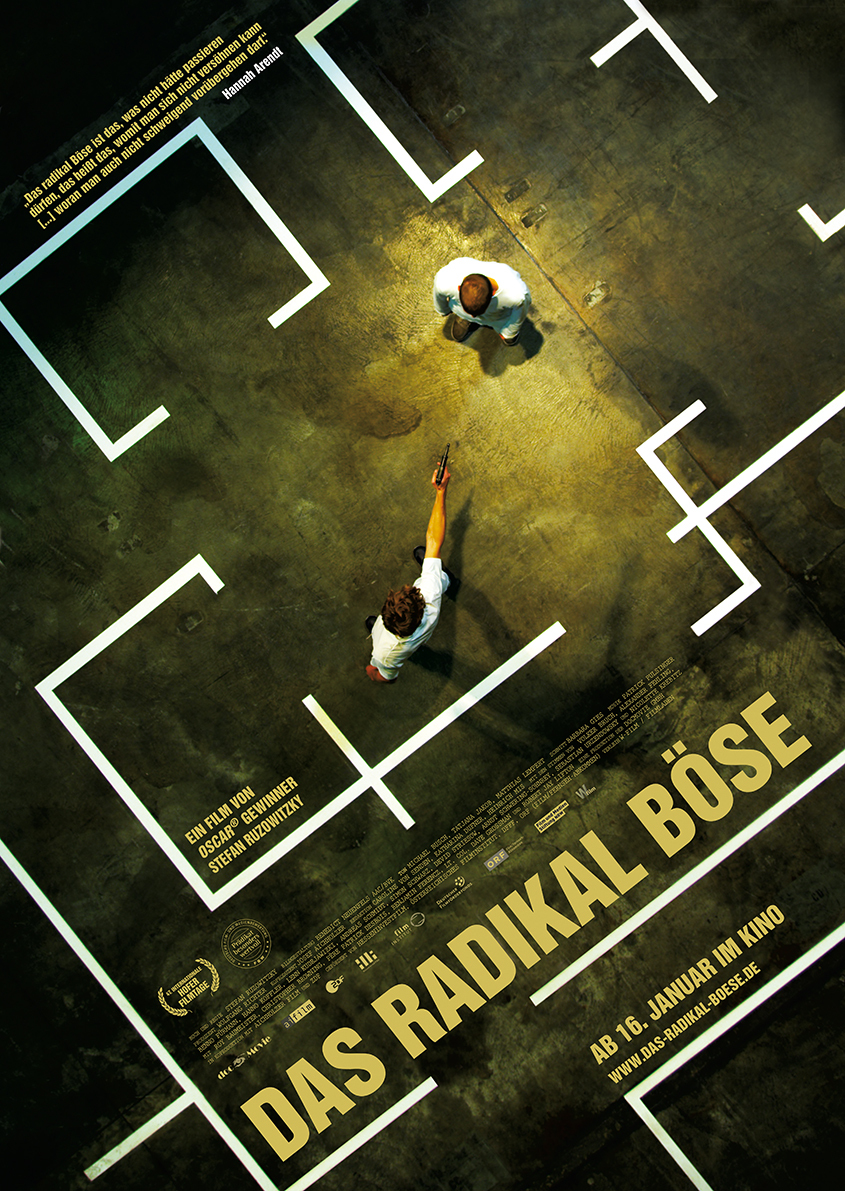
There were two main problems I had with the film. One was the utter lack of any women in it (apart from one female voice who gets to read some descriptions). I mean, you take your title from Hannah Arendt and yet you never refer to her work in your film? You make a film about the human condition but you completely disregard half of humanity and what they might think about that stuff? Was it really impossible to find one female historian/psychologist/philosopher/… to interview on the subject?
The other thing was that Ruzowitzky sticks to the utter basics of psychology to explain the behavior. I’ve had one introductionary Social Psychology class (that wasn’t particularly good) and I knew all the research he quoted. If your insight doesn’t move past Milgram and the Stanford Prison Experiment, there’s nothing actually new you bring to the table. It’s not even obscure knowledge. It’s commonplace and that’s frustrating.

That being said, I liked the rest of Ruzowitzky’s approach. He has actors read out the passages from the diaries and letters and most of what you see are the soldiers themselves (well, also played by – other – actors), often in close-ups. It doesn’t always work – sometimes it’s a little much. But he always nails it with the experiments that are talked about and which are represented rather symbolically and minimalistically.
But the best thing about the film were the experts he interviewed. They all researched and worked on genocide and the killing mentality and had fascinating things to say. If you’re interested in the subject, I’d suggest that you start reading their stuff – especially Lifton and Grossman really caught my eye. And maybe that further reading will give you the insight the documentary itself is lacking.

Summarizing: it’s okay, but nothing more.
 kalafudra's Stuff
A few years ago (ok, maybe not ‘a few’, I think it was something like between 1996 and 1999) I went to an exhibition about the role of the German ‘normal’ army during WWII ans there were exerpts of interviews with ex-soldiers. They were old and had been 19 at the time of the war and one of them said something that shocked me and that I still remember.
He said they weren’t like the SS doing the real mean stuff, only bullying Jews a little bit. What did he mean by ‘bullying’? No big deal. Kicking an elder woman so she fell down the hill.
50 years later, he still didn’t get it. :(
People don’t learn easily. Especially if learning would mean – as in this case – that they’d have to completely reconstruct their own image of themselves. Rather stick to the protection of “the others were the bad ones”.
But yeah, you still expect it. You expect some sort of epiphany and it’s shocking when it isn’t there. When you hear quote after quote about how it was absolute normality to dig graves and then shoot people – including children – to fill them up.
With events that massive, it’s no surprise we’re still working on them.
I share your opinion; the film is certainly lacking. For me its reconstructed footage prevented any connection to the real people that we were trying to reconsider. This indirect approach to such directly personal concepts was a poor and contradictory choice by Ruzowitzky.
The lack of an active female voice also grated with me, and stood out a little too much. I do however believe that the film’s title comes from Immanuel Kant (http://en.wikipedia.org/wiki/Radical_evil), so we might at least let him off the hook on that one!
You can read deeper into my thoughts on the film here: http://wp.me/p4bv5I-4B
I’d love to start up a discussion and talk with you further!
For me the problem was not so much the reconstructed footage but the imagery it used that was sometimes at once full of pretended depth and unsubtle shallowness.
I liked that with the footage that he created he got to go up close and personal with his soldiers. As you see their faces and hear the letters being read, I think it achieves exactly what you didn’t get from it: the reality and personality of those soldiers. Often, though, the images and shots were exactly like what you could have gotten from historic footage (I’m thinking about the “photo shoot”). To me, it would have been interesting if he had taken archive material for that and mixed it with the new close-ups.
The symbolic, minimalistic approach really works for the experimentes though. It captures their essence quickly and without much fuss.
I said that they took the title from Hannah Arendt because they quote her take on radical evil on the movie poster (at least on the Austrian version which I’m assuming is the same as the German version). Well, I guess I should be happy that he included at least one woman as much as that. He could have quoted Kant instead. ;)